A cheaper roofing lead can still cost more to turn into an appointment.
Imagine two roofing companies buying leads.
One pays $200 per lead. The other pays $300.
At first glance, the first contractor appears to have the better deal. But if the second contractor books more inspections from fewer inquiries, the economics could look completely different.
That's the problem with evaluating roofing lead generation using cost per lead (CPL) alone.
For contractors comparing Google Ads, exclusive roofing leads, and other acquisition channels, a better question is:
How much does it actually cost to book a qualified roofing appointment?
What Is Cost per Booked Appointment in Roofing Lead Generation?
Cost per booked appointment measures how much a roofing company spends on lead acquisition to generate one scheduled, qualified inspection or estimate.
The formula is simple:
Cost per booked appointment = Total acquisition cost ÷ Qualified appointments booked
For example, if a contractor spends $6,000 acquiring roofing leads and books eight qualified appointments:
$6,000 ÷ 8 = $750 per booked appointment
That number offers more context than CPL because it accounts for what happens after a homeowner submits an inquiry.
It also helps contractors compare different acquisition models using the same outcome.
A booked appointment should mean a scheduled consultation or inspection that meets the contractor's agreed requirements. A form submission, unanswered call, or unconfirmed calendar request should not automatically count.
How Much Do Roofing Leads Cost in Google Ads?
Roofing is a competitive category in paid search, but benchmark figures need context.
According to LocaliQ's 2025 Home Services Search Advertising Benchmarks, the Roofing & Gutters category recorded:
- $228.15 median cost per lead
- $10.70 median cost per click
- 3.70% median click-to-lead conversion rate
The research analyzed 3,211 US home-services search advertising campaigns across Google and Microsoft Ads, running between April 2024 and March 2025. These are historical category-level medians, not October 2026 roofing prices or results from IntelHouse.
More importantly, the figures do not tell us how many leads became inspections, how many appointments were completed, or how many jobs were sold.
That's the missing layer.
A contractor could generate leads at a cost below the industry benchmark and still struggle to fill the inspection calendar.
Another could pay more per inquiry but generate appointments that fit its service territory, project requirements, and sales capacity.
Neither outcome is guaranteed by the acquisition channel alone.
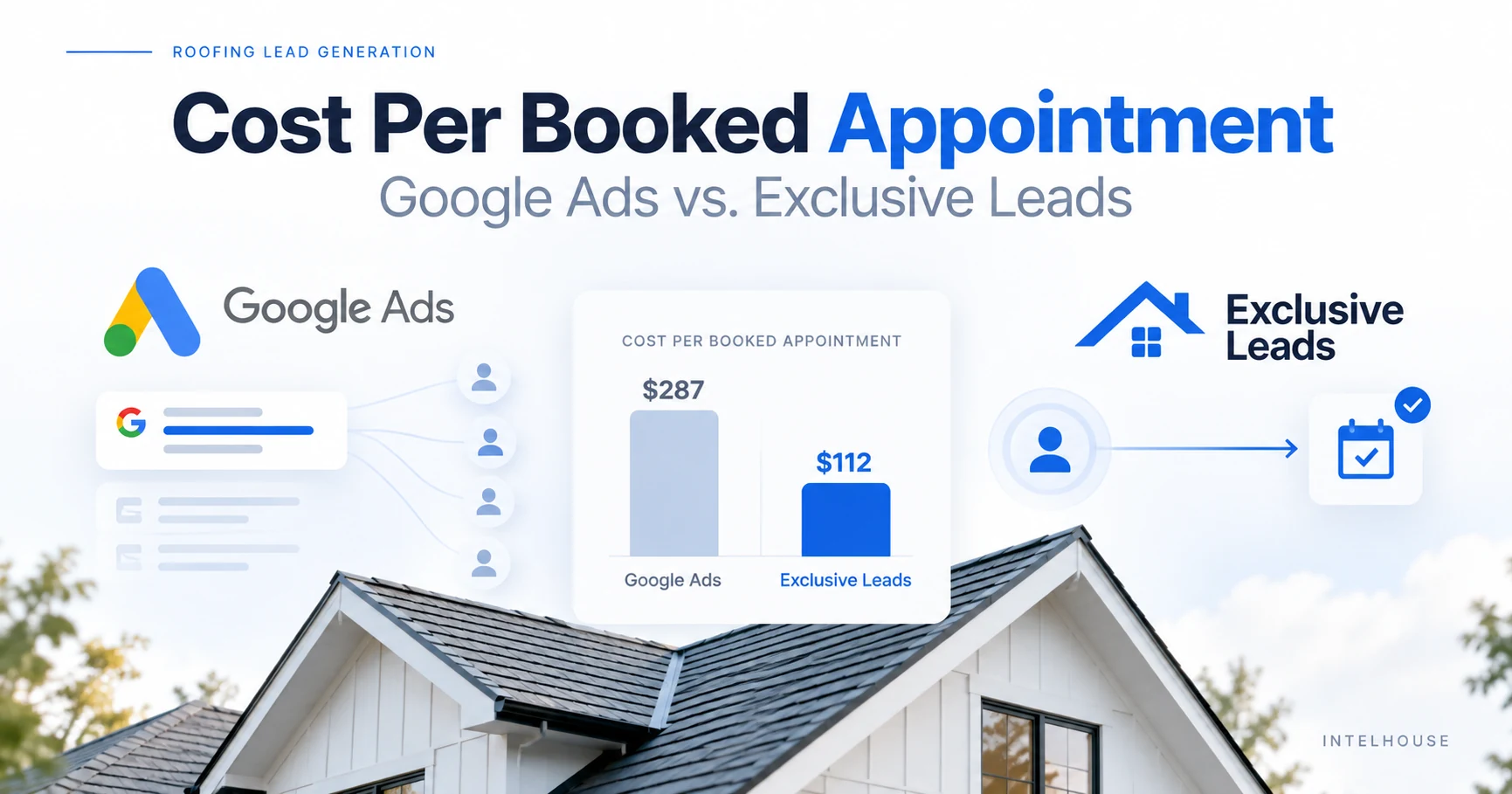
Google Ads vs. Exclusive Roofing Leads: Which Produces Cheaper Appointments?
There isn't a universal winner.
Google Ads allows contractors to acquire inquiries through campaigns they manage directly or through a marketing agency. The business has visibility into advertising spend, targeting, search activity, and the landing pages used to capture inquiries.
Exclusive roofing lead programs operate differently. A lead provider generates and qualifies an opportunity, then delivers it to one buyer under the agreed distribution terms.
The difference is not simply where the homeowner comes from.
It's how the opportunity is acquired, qualified, delivered, and measured.
Consider this hypothetical comparison.
Scenario A: Google Ads
A roofing contractor spends $6,000 in total acquisition costs.
- Leads generated: 30
- Cost per lead: $200
- Qualified appointments booked: 6
- Lead-to-appointment rate: 20%
- Cost per booked appointment: $1,000
Scenario B: Exclusive Roofing Leads
The same contractor spends $6,000 purchasing exclusive roofing opportunities.
- Leads purchased: 20
- Cost per lead: $300
- Qualified appointments booked: 8
- Lead-to-appointment rate: 40%
- Cost per booked appointment: $750
In this illustration, the higher-priced lead source produces a 25% lower cost per booked appointment.
These figures are hypothetical, not a benchmark or forecast for either channel. The comparison demonstrates how to calculate the outcome, not what conversion rate exclusive leads will achieve.
The result could just as easily favor Google Ads when its campaign generates better-matched opportunities or when an exclusive lead provider fails to meet qualification expectations.
The channel that wins is the one producing more economically valuable outcomes for the contractor's specific business.
Why Lead Cost Alone Can Be Misleading
1. Not every roofing inquiry is qualified
A homeowner requesting a minor gutter repair is not necessarily a fit for a roofing company focused on full roof replacements.
Neither is an inquiry outside its installation territory.
Both could count as leads in a campaign report, even if neither is suitable for the buyer.
Project type, service area, property requirements, and homeowner intent need to be considered before measuring usable lead volume.
2. Lead delivery does not equal homeowner contact
A roofing lead can meet every qualification requirement and still fail to become an appointment.
Possible causes include delayed follow-up, missed calls, incorrect routing, or limited sales-team availability.
That doesn't automatically make the original inquiry invalid.
As we explored in Contractor Lead Quality: Is Your CRM Blaming the Wrong Leads?, acquisition problems and follow-up problems should not share the same CRM disposition.
Otherwise, contractors risk changing lead sources when the real problem sits elsewhere in the sales process.
3. Exclusivity and qualification solve different problems
An exclusive lead should mean the provider delivers the opportunity to one buyer and does not intentionally resell or distribute that same inquiry to other contractors.
That can eliminate competition caused by the provider sending the same record to several buyers.
But exclusivity does not guarantee the homeowner will answer, book an inspection, or purchase a roof.
A homeowner may also independently request estimates from other companies.
Before purchasing, contractors should understand the distribution, resale, source, and qualification rules.
Our eight-point guide to verifying exclusive roofing leads explains what to check.
4. A booked inspection isn't a completed inspection
Getting onto the calendar is a meaningful step, but it isn't the final outcome.
A homeowner might cancel, reschedule, or fail to attend.
That is why contractors should monitor three separate numbers:
- Cost per booked appointment: Spend divided by qualified appointments scheduled.
- Cost per completed appointment: Spend divided by inspections or estimates actually held.
- Cost per sold job: Spend divided by roofing projects won.
A source with inexpensive booked appointments may become less attractive if too many fail to happen.
And a channel with expensive appointments may still be profitable if those opportunities consistently turn into the right projects.
How Roofing Contractors Should Measure Lead Performance
To compare Google Ads and exclusive roofing leads accurately, build one reporting process that follows each inquiry from acquisition to outcome.
Step 1: Capture the original source
Record the campaign or lead provider associated with every opportunity.
For paid search, retain the available campaign and click-attribution information.
For purchased leads, record the provider, delivery timestamp, campaign or sub-ID, and relevant qualification fields.
The goal is simple: every appointment should be traceable to the acquisition source that generated it.
Step 2: Separate valid leads from rejected leads
Define rejection reasons before evaluating performance.
Examples include:
- Outside the approved territory
- Wrong roofing service or project type
- Invalid contact information
- Duplicate under the agreed policy
- Inquiry that does not meet documented qualification rules
Don't automatically classify missed contact attempts or unsold estimates as invalid leads.
Step 3: Record the first contact attempt
Track when the inquiry arrived and when the team first attempted contact.
Also record whether contact was made.
These details help distinguish a lead-generation issue from an operational issue.
For real-time inquiries, a sales team should have a clear process for following up while the homeowner's request is still active.
Step 4: Count qualified appointments consistently
Agree on what makes an appointment qualified.
For example, a roofing appointment might need:
- An approved service location
- A roofing project that fits the contractor's services
- A confirmed homeowner appointment
- A scheduled inspection or estimate
Apply the same definition to every lead source.
Without a common definition, channel comparisons become unreliable.
Step 5: Connect appointments to revenue
The final step is to connect the appointment record to the job outcome.
Track whether the appointment was completed, whether an estimate was issued, whether the work was sold, and the gross profit associated with the project.
Google Ads also provides qualified-lead and converted-lead conversion goals for advertisers using offline conversion information from their CRM or other sales systems.
These capabilities can help measure outcomes beyond the initial form submission when the integration is correctly configured.
The important part is not adding more reports.
It's ensuring that marketing and sales are reporting on the same customer journey.
What Is a Good Cost per Booked Roofing Appointment?
There is no single national figure that applies to every roofing contractor.
The affordable appointment cost depends on job economics and sales performance.
A contractor specializing in large roof replacements may be able to support a different acquisition cost than a business focused on smaller repairs.
To work backward from profitability, estimate:
- The expected gross profit per sold roofing job.
- The percentage of booked appointments that become sold jobs.
- The share of that expected gross profit the business is willing to spend acquiring customers.
For example, suppose a contractor expects $5,000 in gross profit per completed job, sells 20% of booked appointments, and allocates 30% of expected gross profit to acquisition.
The resulting planning ceiling would be:
$5,000 × 20% × 30% = $300 per booked appointment
This is an illustrative budgeting calculation. It is not a roofing industry benchmark and does not account for every operational cost or cash-flow consideration.
It demonstrates why appointment targets should come from actual business economics instead of a generic CPL benchmark.
Five Questions to Ask Before Increasing Roofing Lead Spend
Before expanding Google Ads budgets or buying more exclusive leads, contractors should be able to answer:
- How much did each source cost after including the acquisition expenses attributable to it?
- How many delivered inquiries met the agreed qualification requirements?
- How many qualified appointments were booked and completed?
- How many appointments became sold roofing projects?
- Which rejection, contact, or sales outcomes explain the difference between sources?
If those answers aren't available, increasing lead volume may simply increase uncertainty.
The first priority should be improving measurement.
Frequently Asked Questions
Is cost per booked appointment better than cost per lead?
It is usually more useful for evaluating appointment generation because it reflects both acquisition cost and the number of qualified appointments produced. Cost per lead remains helpful for diagnosing earlier funnel performance.
Are exclusive roofing leads always better than Google Ads leads?
No. Exclusive distribution can reduce competition created by sharing the same lead among multiple buyers, but it does not guarantee appointment bookings or sales. Both channels should be evaluated against the same qualification and outcome criteria.
How do I calculate roofing lead-to-appointment conversion rate?
Divide the number of qualified appointments booked by the number of leads acquired, then multiply by 100. Keep the date range, attribution window, and appointment definition consistent across channels.
Should roofing contractors measure booked appointments or sold jobs?
Both. Booked appointments help evaluate marketing and scheduling performance. Sold jobs, acquisition cost per sale, and gross profit reveal whether those appointments generate commercially worthwhile outcomes.
The Bottom Line: Buy Measurable Opportunities, Not Just Lead Volume
A low cost per lead is useful only when those leads contribute to the business.
For roofing contractors, the meaningful comparison is not simply Google Ads versus exclusive leads.
It's whether each source delivers qualified opportunities, whether the sales team can convert them into appointments, and whether those appointments become profitable projects.
IntelHouse focuses on exclusive, one-buyer lead delivery, buyer-specific targeting, and source-level visibility across the lead journey.
If your team is comparing roofing lead sources, start with the requirements for a qualified opportunity and the outcomes you actually need to measure.
Explore IntelHouse's exclusive home improvement leads or book a Lead Flow Review to discuss your acquisition requirements.