A homeowner requests a roofing estimate at 2:14 PM.
The inquiry reaches the contractor's system. The project fits the service area. The homeowner has provided contact details and wants to discuss a roof replacement.
Nobody calls until 4:02 PM.
No answer.
One more attempt the following morning. Still nothing.
By lunchtime, someone updates the CRM:
Bad lead.
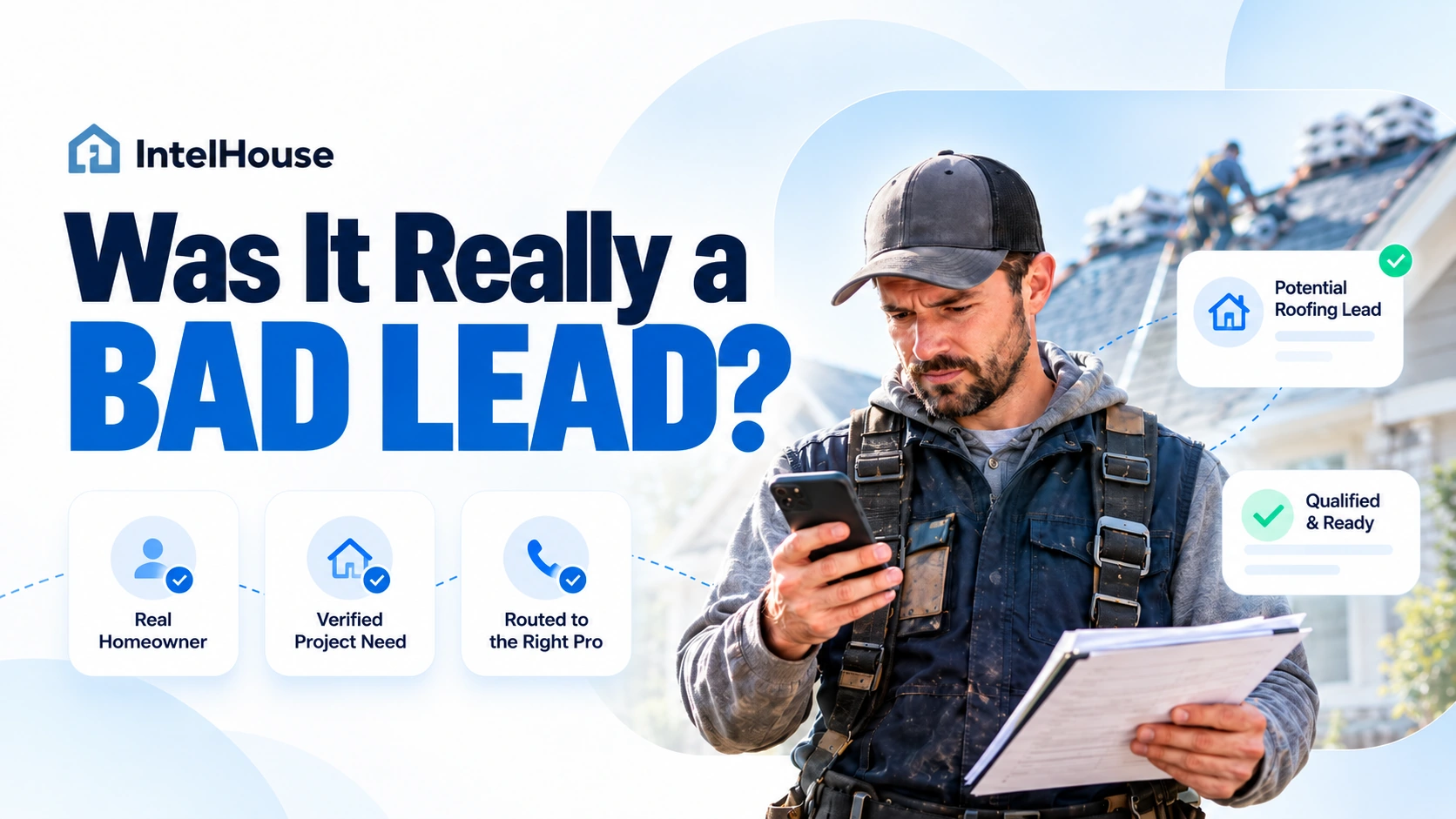
But what was actually bad?
The homeowner's project? The contact information? The advertising campaign?
Or the fact that nobody reached the homeowner while they were actively looking for a contractor?
This is an illustrative scenario, but the reporting problem is real.
Across roofing, HVAC, windows, and remodeling, lead performance gets much harder to understand when every unsuccessful opportunity ends up with the same label.
A lost opportunity and a bad lead are not necessarily the same thing.
And confusing the two can influence which campaigns get scaled, which lead providers get blamed, and where marketing budgets go next.
What Is a Bad Lead in Home Service Lead Generation?
A bad contractor lead is an inquiry that fails agreed qualification or validity requirements, such as the wrong service, an excluded location, invalid contact details, or a duplicate under the buyer's documented rules.
A lead that does not answer the phone is different.
So is a qualified homeowner who books an estimate but chooses another contractor.
Lead quality describes whether an inquiry meets the requirements of a usable opportunity. Sales outcomes describe what happens after that opportunity enters the business.
Those two measurements are connected, but they should not be interchangeable.
For home improvement contractors buying leads, this distinction is the foundation of useful performance reporting.
Why Your CRM Might Be Reporting Lead Quality Incorrectly
A CRM is only as useful as the information entered into it.
Imagine three roofing inquiries.
One comes from a homeowner outside the contractor's approved service territory.
Another comes from someone requesting a legitimate roof replacement, but the sales team never completes a contact attempt.
The third homeowner speaks with the company, receives an estimate, and chooses a competitor.
All three fail to generate a sale.
But only the first clearly indicates a qualification mismatch.
The second raises a follow-up question.
The third raises a sales conversion question.
If all three are marked "bad lead," the CRM loses the information needed to distinguish acquisition problems from operational problems.
That creates a chain reaction.
Marketing sees poor lead quality.
The sales team complains about the source.
The lead provider questions the dispositions.
Budgets change.
And nobody knows which part of the customer acquisition process actually failed.
The solution isn't another dashboard.
It's better classification.
How Can Contractors Tell Whether a Lead Was Bad or Follow-Up Failed?
Start by examining four records: qualification, delivery, contact activity, and final outcome.
If an inquiry fails documented service or territory requirements, investigate acquisition and qualification.
If it meets those requirements but has no successful contact, inspect the routing and follow-up process before assigning blame.
If the homeowner was contacted and qualified but never booked, investigate the sales process.
If an appointment occurred but no job sold, examine the later-stage conversion reasons.
The goal is to identify the stage where the opportunity was lost, not force every unsuccessful outcome into one category.
The IntelHouse Lead Failure Audit: Four Questions to Ask
At IntelHouse, our lead generation approach is built around buyer-defined qualification, controlled acquisition sources, real-time delivery, and feedback that can inform future optimization.
Those principles provide a useful way to investigate disputed lead quality.
The following four-question diagnostic can be applied to a contractor's own CRM and lead-provider records.
1. Did the lead actually meet the agreed qualification criteria?
Start with what the contractor agreed to buy.
For a roofing campaign, that might include:
- An approved ZIP code or service territory
- Roof replacement rather than a repair-only request
- A relevant property or project type
- A usable contact method
- Any agreed homeowner or project qualification rules
- Appropriate consent and acquisition records
Now compare the inquiry against those requirements.
If a contractor only serves residential roof replacements in Dallas and receives a commercial roofing request in Houston, that's a meaningful qualification issue.
If the inquiry matches the defined requirements, it should not automatically be rejected because the sale didn't happen.
Qualification criteria need to be established before performance is judged, not rewritten whenever a campaign produces a disappointing result.
2. Did the opportunity reach the correct sales team?
Next, verify delivery.
Was the inquiry routed to the intended buyer?
Did the CRM actually receive the record?
Was it assigned to someone responsible for follow-up?
Did it reach the correct location or team?
Can you verify the delivery timestamp?
A homeowner can submit a perfectly legitimate HVAC inquiry that never reaches the right dispatcher.
The acquisition may have worked.
The handoff may not have.
This is why delivery records matter.
If the campaign shows a successful handoff but the sales team never sees the inquiry, the next investigation should focus on the CRM integration, assignment rules, alerts, and routing.
3. What happened during follow-up?
An attempted call is not the same as a conversation.
A conversation is not the same as qualification.
And qualification is not the same as a booked appointment.
Track those events separately.
Useful contact records include:
- Time of first attempted contact
- Number and type of compliant contact attempts
- Whether two-way communication occurred
- Whether the homeowner confirmed the project
- Whether an appointment was offered
- Why the opportunity did not progress
Consider a bathroom remodeling inquiry submitted during working hours.
The homeowner's location and project fit the contractor's requirements.
The CRM contains one unsuccessful call attempt, followed by "bad lead."
That disposition establishes a contact failure.
It does not establish that the inquiry was unqualified.
A contractor should investigate its contact process and, where appropriate, continue follow-up within consent and applicable contact rules.
4. Did the opportunity progress to an actual business outcome?
Once a homeowner has been contacted, the next question becomes more commercial.
Did they qualify?
Was a consultation scheduled?
Did the estimate happen?
Was a proposal delivered?
Did the customer purchase?
If not, why?
A roofing homeowner who rejects an estimate because of pricing is different from someone who requested a service the company doesn't provide.
Both might become closed-lost opportunities.
Only one is necessarily a lead qualification problem.
This is also where source attribution becomes valuable.
When appointment and sales outcomes can be connected to their original campaigns, contractors gain a clearer picture of which sources produce valuable opportunities rather than simply cheap inquiries.
The CRM Lead Dispositions Contractors Should Track
You don't need fifty different CRM statuses.
You need a few well-defined stages and reasons that people use consistently.
Contact and lifecycle stages
Track these as the opportunity progresses:
- New: The inquiry was received and awaits processing or follow-up.
- Contact attempted: An approved contact attempt occurred, but no conversation was established.
- Contacted: Two-way communication took place.
- Qualified: The opportunity meets documented buyer requirements.
- Appointment booked: A consultation or estimate was scheduled.
- Appointment completed: The consultation actually occurred.
- Sold: The opportunity became a customer.
- Closed lost: The opportunity did not convert, with a recorded reason where known.
Disqualification and loss reasons
Track these separately from the lifecycle stage:
- Wrong service requested
- Outside approved territory
- Duplicate under the agreed policy
- Verified invalid contact details
- Did not meet project requirements
- Unable to reach after the defined contact process
- Appointment canceled or not attended
- Customer selected another contractor
- Price or financing objection
- Customer postponed the project
- Other documented reason
- Unknown or not yet established
This separation matters.
"Closed lost" tells you the outcome.
"Customer selected another contractor" tells you why.
"Contact attempted" tells you what happened.
"Bad lead" often tells you almost nothing.
One additional rule makes this framework more reliable: do not allow a missing outcome to silently become a negative outcome.
Unknown should remain unknown until there is enough evidence to classify the opportunity.
Example: When 14 Bad Leads Weren't All Bad Leads
Consider a hypothetical home improvement company that purchases 40 inquiries during a reporting period.
Its CRM shows 14 bad leads.
The initial report suggests that 35% of the purchased opportunities were poor quality.
Before reducing spend, the acquisition and sales teams review the underlying records.
They find:
- Five inquiries failed agreed service or location requirements.
- Three were duplicates under the documented policy.
- Six matched the initial requirements but were closed after unsuccessful or incomplete contact activity.
The CRM had grouped all fourteen together.
After reviewing the records, eight have documented qualification or validity issues.
The remaining six have unresolved contact outcomes.
Those six are not necessarily good leads.
They are not necessarily bad leads either.
The evidence is incomplete.
That is a much more actionable conclusion than reporting a 35% bad-lead rate.
The acquisition team can examine the eight documented qualification issues.
The sales team can review the six contact outcomes.
The business can investigate the problems separately instead of making a single decision about the entire lead source.
These figures are illustrative and do not represent IntelHouse customer results or industry benchmarks.
Which Lead Quality Metrics Should Contractors Measure?
Once CRM dispositions are consistent, lead generation reporting becomes more useful.
Five measurements are particularly important.
Contact rate
Contact rate measures the percentage of delivered inquiries that result in successful contact.
Contact rate = Contacted leads ÷ Delivered leads × 100
A low contact rate should trigger a review of contactability, call handling, response speed, assignment, and follow-up records.
It does not automatically prove that the advertising source is poor.
Qualification rate
Qualification rate measures the percentage of evaluated inquiries that meet agreed requirements.
Qualification rate = Qualified leads ÷ Evaluated leads × 100
Define what counts as evaluated.
Some businesses calculate qualification against all delivered inquiries, while others calculate it only against inquiries assessed sufficiently to make a decision.
Either approach needs a clearly labeled denominator. Otherwise, two reports can display different qualification rates for the same underlying leads.
Appointment booking rate
Appointment booking rate measures how often eligible inquiries become scheduled consultations.
Appointment booking rate = Booked appointments ÷ Qualified leads × 100
It helps identify whether the sales team is converting qualified opportunities into actual next steps.
Appointment completion rate
A booked appointment isn't necessarily a completed estimate.
Appointment completion rate = Completed appointments ÷ Booked appointments × 100
Tracking both helps separate scheduling performance from cancellations, no-shows, and appointment completion.
Cost per sold job
Cost per lead tells you how much you spent generating an inquiry.
Cost per sold job connects acquisition spending to actual customers.
Cost per sold job = Acquisition spend ÷ Jobs sold
Use a consistent reporting window and attribution method, especially when sales take weeks or months to close.
And compare trades separately.
An emergency HVAC repair, full system replacement, roofing installation, and bathroom remodel can have very different sales cycles, margins, and economics.
A single blended CPL doesn't explain those differences.
For more on how changing demand and source mix affect these numbers, read Why HVAC Leads Get More Expensive in Fall.
Why Lead Source Attribution Matters More Than Another CPL Report
Two campaigns can deliver the same number of leads at similar costs and produce very different outcomes.
One might generate a large number of low-fit project requests.
Another might produce fewer inquiries, but more qualified appointments.
If the CRM only records "lead received," that difference is difficult to see.
A more useful attribution record connects:
Traffic source → Campaign → Inquiry → Qualification → Delivery → Contact → Appointment → Sale
Where available, campaign and SubID information can help break down results by source, placement, creative, and buyer criteria.
This is especially useful for companies buying across multiple sources or territories.
Without reliable attribution, a business may pause a promising campaign because its booked jobs were never associated with the originating lead source.
Or continue funding a weak campaign because the reporting stops at submitted forms.
The objective isn't to collect every possible metric.
It's to maintain enough trustworthy information to make better spending decisions.
How Accurate CRM Data Can Help Google Ads Optimization
Google Ads supports measuring lead activity that happens after the initial website interaction through products such as enhanced conversions for leads and offline conversion imports.
That can help eligible advertisers connect qualified leads and later conversion events to their advertising activity.
But the quality of the CRM data matters.
If a sales team marks every unanswered inquiry as unqualified, or fails to record successful appointments, the conversion data becomes less useful.
The advertising platform cannot automatically determine whether an inaccurate disposition reflects a targeting problem or a follow-up problem.
Before using offline sales outcomes for campaign optimization, verify that:
- Conversion events have consistent definitions.
- Duplicate events are handled appropriately.
- Lead records can be matched to the relevant advertising interactions.
- The right conversion events are used for campaign goals.
- Reporting can distinguish early-stage inquiries from meaningful downstream outcomes.
Google's documentation also describes the June 2026 migration of supported offline conversion upload workflows toward the Data Manager API.
For implementation requirements, refer to Google Ads Help: About Offline Conversion Imports.
The larger lesson is simple.
Better automation doesn't compensate for unreliable reporting.
If the underlying customer outcomes are wrong or incomplete, more sophisticated campaign tools don't automatically make the decisions better.
How IntelHouse Approaches Lead Quality and Delivery
At IntelHouse, we focus on generating homeowner demand through in-house acquisition rather than reselling the same opportunity across multiple buyers.
Our campaigns are structured around agreed requirements, including service category, location, project fit, and buyer-specific qualification criteria.
Qualified opportunities are matched and routed to an appropriate buyer, with source-level information and delivery records supporting visibility into acquisition performance.
But there's an important boundary.
A qualified lead is not a guaranteed appointment or sale.
A homeowner may change their mind.
They may be comparing prices.
They may not answer a callback.
They may book an appointment and postpone the project.
The sales team may fail to follow up effectively.
Lead generation can address acquisition, qualification, and delivery. Sales conversion also depends on what happens after the opportunity reaches the buyer.
That's why buyer feedback matters.
When a contractor distinguishes invalid inquiries from unreachable opportunities, booked appointments, and completed sales, the feedback becomes more useful for refining targeting and qualification.
You can explore how IntelHouse generates, qualifies, and routes home improvement leads or review our lead generation FAQs.
A Five-Minute Lead Quality Audit for Your Next Campaign Review
Before deciding that a source is underperforming, choose a recent set of leads and ask:
- Qualification: Which inquiries demonstrably failed the agreed buyer requirements?
- Delivery: Which opportunities reached the correct CRM, location, and responsible team?
- Follow-up: Which leads received appropriate contact attempts, and which resulted in conversations?
- Outcomes: Which opportunities progressed to appointments, completed estimates, and sold jobs?
- Attribution: Can the final results be traced to the correct source or campaign?
You don't have to solve every problem immediately.
First, separate the evidence.
Then prioritize the issue with the clearest impact on business outcomes.
An out-of-territory campaign needs different corrective action from a routing failure.
And a routing failure needs different corrective action from an estimate that never converts into a sale.
That distinction is where a useful optimization process begins.
Frequently Asked Questions About Contractor Lead Quality
What is a bad lead in home improvement marketing?
A bad lead is an inquiry that fails documented qualification or validity requirements. Examples include an excluded service area, the wrong project type, verified invalid contact information, or a duplicate under the agreed policy. An inquiry that doesn't convert into a sale is not automatically a bad lead.
How can contractors identify poor-quality leads?
Compare every inquiry against agreed service, location, project, and contact requirements. Then review delivery timestamps, contact attempts, qualification results, appointment activity, and final outcomes. This helps distinguish genuine acquisition-quality issues from problems occurring after delivery.
Is an unanswered contractor lead a bad lead?
Not necessarily. An unanswered lead indicates unsuccessful contact, not automatically poor qualification. The contractor should investigate contact details, response timing, assignment, and compliant follow-up before making a final determination.
What CRM dispositions should roofing and HVAC companies use?
At minimum, track new, contact attempted, contacted, qualified, appointment booked, appointment completed, sold, and closed lost. Maintain separate reasons for disqualification or loss, such as wrong service, outside territory, duplicate, invalid contact details, unreachable, or customer selected a competitor.
What's the difference between lead quality and lead conversion?
Lead quality describes whether an inquiry is relevant and meets agreed eligibility requirements. Lead conversion describes whether the opportunity progresses through contact, qualification, booking, and sales stages. A qualified lead can fail to convert without necessarily being a poor-quality inquiry.
Can better CRM reporting reduce wasted marketing spend?
It can help identify waste more accurately. Consistent dispositions and reliable source attribution reveal whether problems originate in targeting, qualification, routing, follow-up, or sales conversion. Better information can support smarter budget allocation, but it does not guarantee lower acquisition costs.
How should contractors compare lead generation providers?
Compare qualification requirements, service-area fit, lead exclusivity rules, source transparency, delivery methods, duplicate policies, invalid-lead procedures, and actual downstream outcomes. Cost per lead alone does not establish which provider creates the best commercial value.
For more context, see our guide to verifying exclusive roofing leads.
Final Thought: Stop Asking Whether the Lead Was Bad
Start asking what actually happened to it.
Did the opportunity match the campaign requirements?
Did it reach the right sales team?
Was the homeowner contacted?
Was an appointment booked?
Did the estimate happen?
Did the job sell?
And if not, where did the process break?
Those answers are more valuable than another weekly report filled with "bad lead" dispositions.
Because better lead generation isn't just about producing more inquiries.
It's about creating qualified opportunities, getting them to the right people, and understanding what happens next.
Want more visibility into your home improvement lead flow?
Explore IntelHouse's exclusive home improvement lead generation or book a Lead Flow Review to discuss your target markets, qualification requirements, and delivery process.