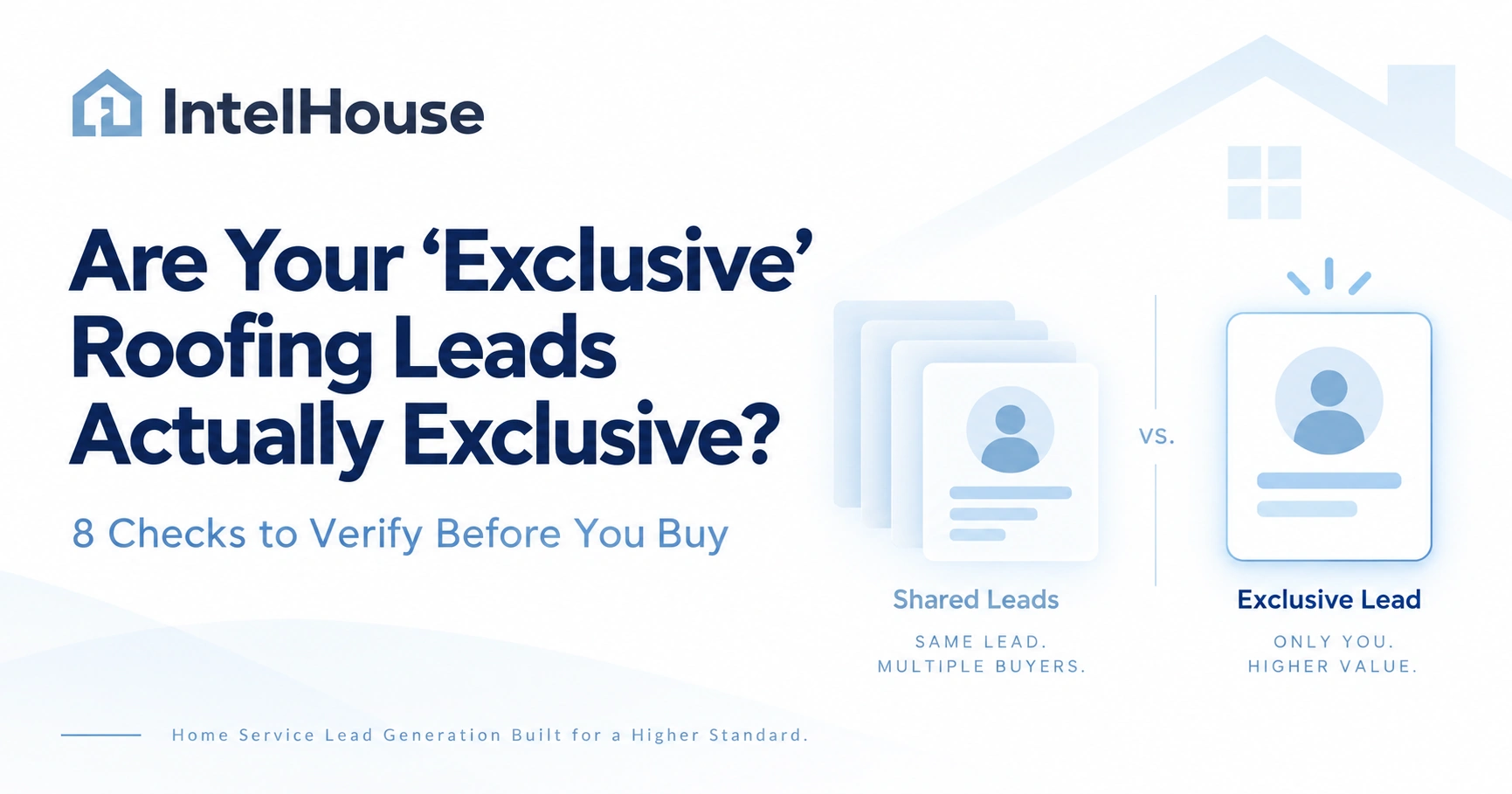
“Exclusive roofing leads” sounds simple.
One homeowner. One roofing contractor.
But in practice, the word exclusive can describe very different lead-distribution models.
A lead might be exclusive for a limited period. It might be exclusive within one network. It might be restricted to a specific territory. Or it might genuinely be delivered to one buyer and never distributed again.
For roofing contractors, that difference matters.
Before comparing lead prices, ask a more useful question:
What actually happens to the homeowner opportunity before and after it reaches your team?
What is an exclusive roofing lead?
An exclusive roofing lead should mean that the lead provider delivers a homeowner opportunity to one buyer and does not intentionally distribute, resell, or recycle that same opportunity to competing contractors.
That definition describes distribution.
It does not automatically mean the homeowner is qualified.
It does not guarantee they will answer the phone.
And it does not mean the homeowner has not independently contacted another roofing company.
That distinction is important:
Exclusivity controls who the lead provider sends the opportunity to. Qualification determines whether the opportunity actually fits your business.
So instead of simply asking whether a provider sells exclusive roofing leads, verify how exclusivity actually works.
---
1. Ask exactly how many buyers receive the lead
Start with the simplest question:
How many companies receive this exact homeowner opportunity?
Do not just ask:
> Are your leads exclusive?
That question leaves too much room for interpretation.
Ask for the actual distribution rule.
A true one-buyer model should be easy to explain:
One approved opportunity is routed to one buyer.
If the answer sounds more like:
- “a limited number of contractors”
- “only contractors in your area”
- “our preferred partner network”
- “up to three buyers”
- “you receive it first”
then ask more questions.
Those may still be legitimate lead products.
They are simply not the same thing as one-buyer exclusivity.
At IntelHouse, the model is built around matching an approved opportunity to one buyer rather than distributing the same opportunity through a shared lead pool.
Learn more about how IntelHouse works
---
2. Find out whether the lead can be resold later
A homeowner opportunity could be delivered only to you today and still be distributed somewhere else tomorrow.
That makes the resale policy just as important as the first delivery.
Ask:
Can this homeowner's information ever be resold, recycled, syndicated, or distributed to another buyer later?
Then ask whether there is an exclusivity period.
For example:
- Is the lead exclusive permanently?
- Is it exclusive for 24 hours?
- Is it exclusive until your team attempts contact?
- Can it enter another marketplace later?
- Can the provider recycle it if you reject it?
Those are very different buying models.
The important thing is that the rules are clear before you start spending.
IntelHouse's model is designed around one approved opportunity being routed to one matched buyer rather than resold across multiple buyers.
---
3. Ask what “exclusive” actually applies to
This is where the terminology becomes confusing.
Exclusivity could refer to the individual homeowner opportunity.
It could refer to a territory.
It could refer to a campaign.
It could refer to a specific period of time.
It could even mean a lead is exclusive inside one provider's network while still existing somewhere else.
Do not assume.
Ask the provider:
Exclusive to whom, for how long, and under what conditions?
That question gives you far more useful information than simply seeing “exclusive leads” on a pricing page.
---
4. Verify where the roofing lead actually came from
Exclusivity is only one part of lead quality.
You should also understand the source of the opportunity.
Ask whether the homeowner came through:
- paid search
- paid social
- a roofing-specific landing page
- an inbound phone call
- a comparison website
- a publisher
- a third-party lead exchange
- co-registration
- an aged database
- another acquisition source
The point is not that one source is automatically better than another.
The point is traceability.
If lead quality starts dropping, your team should be able to ask:
Which source, campaign, creative, placement, or funnel produced these opportunities?
Without source visibility, optimization becomes guesswork.
A strong acquisition system should help you trace performance back to where the opportunity originated.
---
5. Compare when the lead was generated with when it was delivered
An opportunity can technically be exclusive and still arrive too late.
That is why roofing contractors should ask for two separate timestamps:
When did the homeowner submit the inquiry?
and
When did the opportunity reach your team?
The difference is your delivery latency.
You should know whether opportunities are reaching you:
- in real time
- several minutes later
- hours later
- as part of a batch
- after they have aged
This matters because exclusivity does not remove the need for fast follow-up.
A homeowner can still independently search for another roofer, ask a friend for a referral, or submit another estimate request.
One-buyer delivery reduces provider-created competition.
It does not eliminate homeowner-created competition.
That distinction matters.
---
6. Ask how duplicate leads are handled
Imagine the same homeowner:
- submits a roofing form on Monday
- calls through another campaign on Wednesday
- submits another request on Friday
Is that three new leads?
Or one homeowner entering the system three times?
Your provider should have a clear duplicate policy.
Ask:
- What counts as a duplicate?
- How long is the duplicate lookback period?
- Are phone numbers checked?
- Are email addresses checked?
- Are property addresses checked?
- Are duplicates checked across different campaigns?
- What happens if the homeowner enters through another source?
- Are duplicate opportunities credited or replaced?
Exclusivity without duplicate control can still create unnecessary sales effort and distorted acquisition numbers.
---
7. Separate exclusivity from qualification
This may be the most important distinction when evaluating roofing leads.
A lead can be completely exclusive and still be a poor opportunity for your business.
For example, the homeowner might be outside your service area.
They may want a minor repair when your team is focused on replacement projects.
The property might not fit your criteria.
The phone number might be invalid.
The homeowner may not be the decision-maker.
Or the project timeline may not match your current capacity.
The lead can still technically be exclusive.
It simply is not qualified for your business.
So the better question is not:
> Are these leads exclusive?
It is:
Exclusive according to what distribution rule, and qualified according to what buyer criteria?
For roofing contractors, qualification criteria may include:
- ZIP code or service radius
- roof repair versus replacement
- residential versus commercial
- project urgency
- property type
- homeowner status
- project size
- storm-related intent
- appointment availability
- current team capacity
IntelHouse campaigns can be structured around buyer-defined criteria such as geography, project type, urgency, and other campaign-specific requirements before an opportunity is routed.
---
8. Ask the provider to show the delivery path
One of the strongest questions you can ask any roofing lead provider is:
Can you show me what happens between the homeowner submitting the inquiry and the opportunity appearing in my system?
A transparent process should be explainable.
It may look something like:
Traffic source → campaign → homeowner inquiry → validation → duplicate check → qualification → buyer match → delivery → outcome
The exact technology does not matter as much as the visibility.
You should be able to understand:
- where the opportunity originated
- why it qualified
- why it was routed to you
- when it was delivered
- whether another buyer received it
- what happened after your team received it
That visibility is what makes it possible to improve acquisition instead of simply blaming “bad leads.”
---
Exclusive does not mean guaranteed
An exclusive roofing lead is not a guaranteed roofing job.
Exclusivity does not guarantee:
- contact
- an appointment
- a completed estimate
- insurance approval
- financing approval
- a signed contract
- immediate homeowner intent
- strong sales-team execution
What exclusivity changes is one important variable:
the lead provider is not intentionally creating additional buyer competition for that same opportunity.
That can be valuable.
But it should still be measured against actual business outcomes.
---
Do not judge roofing leads by cost per lead alone
Cost per lead is useful.
But it is not enough.
A $40 lead that rarely turns into an appointment may be more expensive than a $150 opportunity that consistently turns into viable sales conversations.
Instead, follow the whole funnel.
Track:
Leads delivered
↓
Leads contacted
↓
Qualified opportunities
↓
Appointments booked
↓
Appointments completed
↓
Estimates issued
↓
Jobs sold
Then measure the metrics that actually affect revenue.
Contact rate
How many delivered opportunities did your team successfully reach?
Qualification rate
How many opportunities actually matched your business criteria?
Appointment rate
How many delivered opportunities turned into booked appointments?
Close rate
How many opportunities became sold jobs?
Cost per booked appointment
How much acquisition spend did it take to create a real appointment?
Cost per sold job
How much did you actually spend to acquire a customer?
That final number is often much more useful than the advertised price of an individual lead.
---
What to verify before increasing roofing lead volume
Before scaling spend with a provider, make sure you understand:
- exactly how many buyers receive each opportunity
- whether the opportunity can ever be resold
- whether exclusivity is permanent or time-limited
- where the homeowner came from
- when the inquiry was generated
- when your team received it
- how duplicates are detected
- what makes an opportunity qualified
- which service areas can be targeted
- what happens with invalid or bad-fit leads
- how opportunities are delivered
- whether results can be traced back to their source
You do not need every lead provider to operate the same way.
You do need to understand exactly what you are buying.
---
The better question is not “Are the leads exclusive?”
Ask:
Can you prove how exclusivity works?
The difference matters.
A label tells you what a provider calls its product.
A delivery rule tells you what actually happens.
For roofing contractors evaluating lead generation partners, the strongest setup is one where distribution, qualification, source, routing, and performance can be examined separately.
That gives your team enough information to understand what is happening when performance changes.
Maybe the traffic source changed.
Maybe the ZIP-code mix changed.
Maybe different project types started entering the campaign.
Maybe response time slowed.
Maybe your team's capacity changed.
Maybe qualification weakened.
Without visibility, all of those problems tend to become one vague statement:
> “The leads aren't good.”
With visibility, you can actually identify where the problem is.
---
Frequently Asked Questions
What does an exclusive roofing lead mean?
An exclusive roofing lead generally refers to a homeowner opportunity that a lead provider distributes to one roofing contractor rather than intentionally selling to several competing contractors. Contractors should also verify whether the opportunity can later be resold or recycled and whether exclusivity is permanent or time-limited.
How can I tell whether roofing leads are really exclusive?
Ask how many buyers receive each opportunity, whether it can ever be resold, how long exclusivity lasts, where the lead originated, how duplicates are handled, and whether generation and delivery timestamps are available. The provider should be able to explain the distribution rules clearly.
Are exclusive roofing leads the same as qualified roofing leads?
No. Exclusivity describes distribution, while qualification describes fit. An exclusive opportunity can still fall outside your service area, involve the wrong project type, or otherwise fail your buying criteria.
Can an exclusive roofing lead still be talking to another roofer?
Yes. Provider exclusivity only controls how that provider distributes the opportunity. A homeowner can independently contact other roofing companies, search online, ask for referrals, or request additional estimates.
Are exclusive roofing leads better than shared leads?
Neither model should be evaluated on the label alone. Contractors should compare lead sources using qualification rate, contact rate, appointment rate, close rate, cost per booked appointment, and cost per sold job.
What should I ask a roofing lead generation company before buying leads?
Ask about buyer count, resale rules, acquisition source, qualification criteria, duplicate handling, service-area filters, delivery speed, invalid-lead policies, and source-level reporting. Important definitions should be clear before increasing volume.
How quickly should roofing leads be delivered?
High-intent roofing opportunities are generally more useful when they reach the contractor quickly. Contractors should ask providers for both the inquiry-generation timestamp and the delivery timestamp so they can measure how much time passes before the opportunity reaches their sales team.
Can roofing leads be filtered by project type?
That depends on the provider. More configurable lead-generation programs may allow contractors to define criteria such as geography, repair versus replacement, project size, urgency, or other business requirements before an opportunity is accepted.
---
One buyer is only one part of the equation
IntelHouse structures home-service campaigns around one-buyer delivery, real-time routing, source visibility, and buyer-defined qualification criteria.
The objective is not simply to generate more names.
It is to make three questions easier to answer:
Where did this opportunity come from?
Why was it sent to us?
What happened after we received it?
If your current lead program cannot answer those questions, that is a useful place to start.