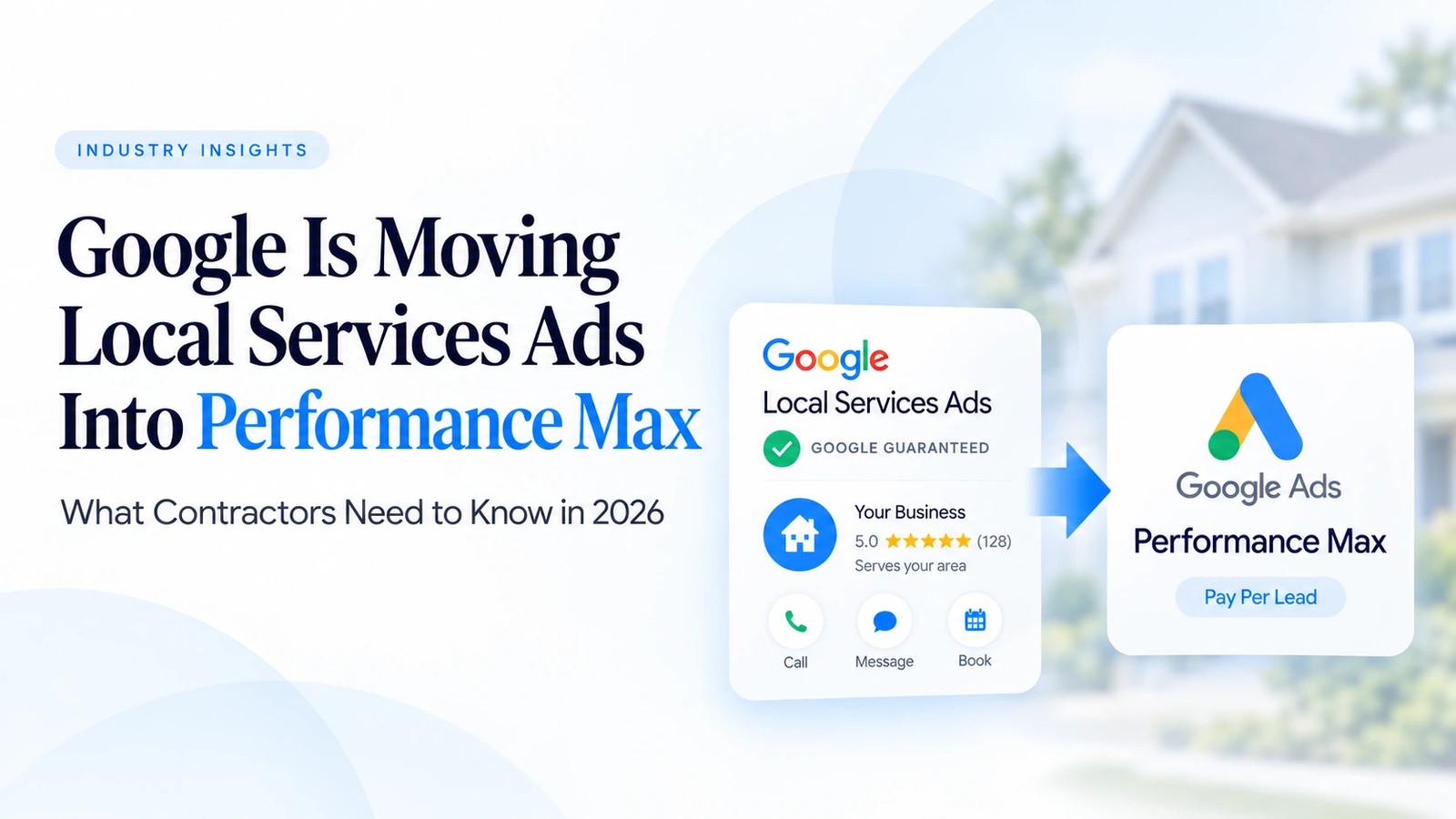
Google Local Services Ads are changing.
Starting August 1, 2026, Google began transitioning Local Services Ads into Google Ads as a specialized type of Performance Max campaign built around pay-per-lead goals.
For contractors who rely on Local Services Ads for roofing, HVAC, plumbing, electrical, remodeling, cleaning, pest control and other home services, this is a significant change.
But it is also easy to misunderstand.
Google is not simply turning your Local Services Ads into the standard Performance Max campaigns advertisers have been using for years.
The new setup keeps much of the Local Services Ads model intact.
You still pay for qualifying leads instead of ordinary ad clicks. Campaigns remain focused on high-intent local customers. Ads continue appearing on Google Search and Google Maps. Targeting remains keywordless.
What changes is where the campaign is managed, how parts of the bidding and budgeting system work, and how much contractors need to think about the data behind their advertising.
And that last part may matter more than the migration itself.
Is Google Getting Rid of Local Services Ads?
Not exactly.
Google is moving the Local Services Ads experience into the main Google Ads platform.
Existing eligible Local Services Ads campaigns will transition into specialized Performance Max campaigns with pay-per-lead goals.
The standalone Local Services Ads management experience is therefore becoming less central, but the advertising model contractors recognize as LSA is not simply disappearing.
The new campaigns are still designed to connect local businesses with people actively looking for their services.
They are still pay per lead.
They are still keywordless.
And they still focus primarily on Google Search and Google Maps.
So when someone says, "Google is replacing LSA with Performance Max," the more accurate explanation is:
Google is moving Local Services Ads into a specialized Performance Max campaign structure designed specifically for pay-per-lead local advertising.
That distinction matters.
When Did the Local Services Ads Migration Start?
Google began the transition on August 1, 2026.
The migration is happening in phases rather than moving every Local Services Ads account at once.
Eligible U.S. home-service and storefront businesses are among the first advertisers being transitioned, with additional categories and markets expected to move into the new system over time.
Contractors should therefore watch both their email and their Local Services Ads account notifications.
If your account has not moved yet, that does not mean the change is irrelevant.
It means you have time to prepare.
And there are several things worth doing before the account moves.
What Stays the Same After LSA Moves Into Performance Max?
The Performance Max name makes this sound like an entirely new advertising product.
In practice, several of the most important characteristics of Local Services Ads remain.
You Still Pay for Leads Instead of Ordinary Clicks
The new Performance Max campaigns use pay-per-lead goals.
That means Google charges the advertiser when a potential customer contacts the business through an eligible lead interaction rather than simply charging because somebody clicked an ad.
Phone calls remain an important lead type.
Depending on campaign availability and configuration, other customer interactions can also become lead goals.
For contractors, this keeps one of the main differences between Local Services Ads and traditional Google Search advertising intact.
Ads Continue Appearing on Search and Maps
Standard Performance Max campaigns can appear across a much wider range of Google advertising inventory.
The pay-per-lead version is different.
These campaigns remain focused on the local environments where Local Services Ads already operate, particularly Google Search and Google Maps.
That means the customer intent behind the campaign remains strongly connected to someone actively looking for a local service provider.
A homeowner searching for an emergency plumber near them is very different from someone casually consuming content about plumbing.
That high-intent behavior is still central to the model.
Campaigns Remain Keywordless
Contractors are not suddenly going to need large keyword lists to operate these campaigns.
The system continues using information about your business, services, service areas and customer intent to determine when your business is relevant.
This means your business information matters enormously.
Your service categories matter.
Your service area matters.
Your Google Business Profile matters.
And the quality of the signals feeding Google's automated system matters.
What Is Actually Changing?
The most obvious change is the platform.
Once an eligible account has migrated, contractors will increasingly manage these campaigns from Google Ads rather than treating Local Services Ads as a completely separate advertising environment.
For businesses already running Search, traditional Performance Max or other Google Ads campaigns, that creates a more centralized acquisition setup.
That sounds convenient.
And in many ways, it is.
But it also creates a measurement problem.
When more of your advertising lives inside the same platform, it becomes very easy to judge the health of your customer acquisition based entirely on the numbers Google gives you.
Spend.
Leads.
Cost per lead.
Conversions.
Those are useful numbers.
They are not the whole business.
Google cannot determine the profitability of a contractor's advertising from cost per lead alone.
To understand that, you need to know what happened after the lead arrived.
Historical Local Services Ads Reporting Needs Attention
One of the most important things contractors should know about the migration is that historical Local Services Ads performance reporting does not automatically move into Google Ads.
That matters.
Imagine trying to compare roofing performance next spring with the previous spring, only to discover that the historical view you relied on is no longer sitting inside your active Google Ads campaign.
Before migration, contractors should preserve the historical information they may need later.
That includes spend, total leads, charged leads, credited leads, cost per lead, lead volume by month, service categories, lead types and any downstream booking or revenue information being tracked outside Google.
Historical data becomes more valuable with time.
Do not discover its value after you lose easy access to it.
Google Business Profile Becomes Even More Important
Performance Max campaigns with pay-per-lead goals use Google Business Profile information as an important part of campaign setup and local targeting.
Core business information can be sourced directly from the profile.
That means contractors should review their Google Business Profile before the migration rather than treating it like an unrelated local SEO asset.
Check the business name.
Check the address.
Check the operating hours.
Check the service categories.
Check the phone number.
Check the service areas.
Check the photos.
Check the profile for information that is old, incomplete or simply wrong.
If Google is using your business data to help determine how your advertising operates, bad business data can become an advertising problem.
Bidding Is Becoming More Automated
The direction of Google Ads has been clear for years.
Google wants more of the campaign decision-making process handled by automation.
Local Services Ads are moving further in the same direction.
For contractors, this creates a bigger question than whether manual bidding options change.
The real question is:
What information are you giving the system to optimize around?
Automation is only as useful as the signals behind it.
If your advertising system knows only that a lead happened, then it optimizes around generating leads.
If your broader acquisition system understands which leads were contacted, which qualified, which booked, which showed up, which sold and which produced meaningful revenue, then you have a much better foundation for making advertising decisions.
That is where contractor acquisition is heading.
Not toward more manual buttons.
Toward better feedback.
The Biggest Mistake Contractors Can Make After This Migration
The biggest mistake is judging campaign performance entirely by cost per lead.
CPL matters.
But it is a top-of-funnel metric.
A cheap lead can be expensive.
An expensive lead can be profitable.
Here is a simple example.
Imagine Campaign A produces 100 leads at $60 each.
That is $6,000 in spend.
Twenty of those leads turn into booked appointments.
The effective cost per booked appointment is $300.
Now imagine Campaign B produces 100 leads at $85 each.
That is $8,500 in spend.
Fifty of those leads turn into booked appointments.
The effective cost per booked appointment is $170.
If you looked only at cost per lead, Campaign A would appear significantly better.
Once you look at actual booking performance, Campaign B becomes much more efficient.
That is the difference between measuring advertising and measuring acquisition.
A Charged Lead Is Not the Same Thing as a Booked Job
This distinction becomes even more important as Google automates more of the advertising system.
Google needs a way to decide whether an interaction qualifies as a billable lead.
Your business needs to answer a different question.
Did this lead create economic value?
A lead can be valid from an advertising platform's perspective and still fail to produce a job.
The customer might never answer the callback.
They might live outside the practical service area.
They might be researching prices.
They might qualify but never book.
They might book and cancel.
They might receive an estimate and choose a competitor.
Or they might become a $15,000 customer.
All of those outcomes can begin with something that looks similar inside an advertising dashboard.
They are not remotely similar inside the business.
This is why contractors should separate lead generation metrics from acquisition economics.
What Contractors Should Actually Measure
The acquisition journey starts with advertising spend, but it should not stop when a form is submitted or the phone rings.
Track how many leads are generated.
Then track how many are actually contacted.
From those, track how many meet your qualification criteria.
Then measure how many appointments are booked.
Measure how many appointments actually happen.
Measure how many estimates or proposals are issued.
Measure how many jobs close.
Then connect those closed jobs back to revenue and gross profit.
Once you can follow that path, you can start answering much more useful questions.
Which campaign gives us the lowest cost per booked appointment?
Which service generates the highest revenue per lead?
Which source produces the highest close rate?
Where are we losing opportunities after the lead arrives?
Which service category can tolerate a higher CPL because the average job value is significantly higher?
These are questions contractors can build a business around.
"Did CPL go down $7 this month?" usually is not.
What Should Contractors Do Before Their LSA Account Migrates?
Save Your Historical Data
Preserve your current LSA reporting before migration.
Take the time to save enough information to compare future performance against your historical baseline.
Seasonality matters enormously in home services, so one month of historical data is rarely enough.
Record Your Existing Campaign Setup
Document your current budget, targeted services, service areas, bidding settings, lead types, schedule and major campaign configuration.
Once the migration is complete, compare the new setup against the old one.
Do not assume every detail deserves to be left unchecked simply because the migration was automatic.
Audit Your Google Business Profile
Make sure the information Google is using about your business is accurate.
Pay particular attention to service categories, operating hours, locations and service areas.
Establish Your Lead Quality Baseline
Before migration, calculate your current contact rate.
Then calculate your qualified lead rate.
Your appointment rate.
Your show rate.
Your close rate.
Your cost per booked appointment.
And ideally, your cost per sold job.
Without a baseline, you cannot confidently determine whether lead quality changed after migration.
Review Your Intake Process
This gets overlooked constantly.
The quality of your advertising cannot compensate forever for a weak intake process.
How quickly are calls answered?
How many go to voicemail?
How quickly are missed calls returned?
Who qualifies the lead?
What information gets recorded?
How consistently does the team ask for the appointment?
A business can pay for an excellent lead and still lose it in under five minutes.
Review Different Service Economics Separately
A plumbing call, a full HVAC replacement, an electrical service request and a roofing opportunity do not necessarily have the same economics.
Do not treat them as interchangeable because Google puts them on the same dashboard.
Look at lead cost in context.
Look at conversion rates.
Look at job values.
Look at gross margins.
Then determine what you can actually afford to pay to acquire each type of opportunity.
What Should Contractors Watch After Migration?
Do not make the mistake of looking only at the first few days.
Automated advertising systems need data.
Customer demand changes by day.
Lead mix changes.
Competitors change budgets.
Weather changes demand.
Your own intake team has strong days and weak days.
Look for patterns rather than reacting emotionally to one bad Tuesday.
Start by watching spend, total lead volume, cost per lead, charged leads, credited leads and service mix.
Then move downstream.
Watch contact rate.
Watch qualification rate.
Watch appointment rate.
Watch show rate.
Watch close rate.
Watch revenue per lead.
Watch cost per booked job.
Watch cost per sold job.
The most useful post-migration question is not:
"Did Google make our leads cheaper?"
It is:
"Did this system produce profitable jobs more efficiently?"
Will Performance Max Make Local Services Ads Better?
Possibly.
Bringing more of Google's advertising ecosystem into one management platform has obvious advantages.
Contractors and agencies managing several campaign types may find it easier to see and manage their Google acquisition activity in one place.
Google Business Profile integration can also reduce parts of the duplicated setup process.
And Google's automation can make campaign management easier for businesses that do not have someone constantly adjusting settings.
But automation creates a tradeoff.
When the platform controls more of the decisions, advertisers need better measurement outside the platform.
The advantage increasingly comes from knowing more about your leads than the advertising platform does.
Google knows that someone became a lead.
You know whether that person answered.
You know whether they qualified.
You know whether they booked.
You know whether they bought.
And you know how much money the job made.
That information should become part of how you evaluate acquisition.
What Does the LSA Migration Mean for Contractor Marketing in 2026?
The move from the standalone Local Services Ads experience into Performance Max with pay-per-lead goals is important.
But it is part of a much larger shift.
Google Ads is becoming more automated.
Campaign targeting is becoming more automated.
Bidding is becoming more automated.
Creative decisions are becoming more automated.
Search itself is becoming more AI-driven.
The contractor's advantage therefore moves away from simply knowing which button to click inside an advertising dashboard.
The advantage comes from better data.
Better qualification.
Faster response.
Cleaner CRM dispositions.
Better routing.
Better sales follow-up.
Better understanding of what a customer is actually worth.
In other words, the future of contractor advertising is not just about generating more leads.
It is about understanding which leads turn into jobs.
Frequently Asked Questions
Is Google Local Services Ads Going Away?
Google is moving eligible Local Services Ads campaigns into Google Ads as specialized Performance Max campaigns with pay-per-lead goals. The standalone management experience is changing, but the core local pay-per-lead advertising model continues.
Is LSA Becoming Regular Performance Max?
No.
Performance Max with pay-per-lead goals is a specialized campaign type designed for local service businesses. It should not be treated as identical to a standard Performance Max campaign.
When Did the LSA to Performance Max Migration Start?
Google began the transition on August 1, 2026. The rollout is happening in phases, so different advertisers may migrate at different times.
Will Contractors Still Pay Per Lead?
Yes.
The new campaign structure continues using a pay-per-lead model for qualifying customer contacts rather than charging the advertiser simply because someone clicked the ad.
Where Will the New Ads Appear?
Performance Max campaigns with pay-per-lead goals continue focusing on Google Search and Google Maps for local customer acquisition.
Will Contractors Need to Add Keywords?
No.
The new campaigns remain keywordless and use information including services, service areas, business categories and Google Business Profile data to help match businesses with relevant local customers.
Will Historical LSA Data Move Into Google Ads?
Historical Local Services Ads performance reports do not automatically transition into Google Ads.
Contractors should preserve the historical reporting they may need for future comparison before migration.
Should Contractors Still Track Cost Per Lead?
Yes, but it should not be the only metric.
Cost per lead becomes much more useful when it is viewed alongside contact rate, qualification rate, appointment rate, close rate, cost per booked appointment, cost per sold job and revenue per lead.
What Is More Important Than a Cheap Contractor Lead?
A lead that turns into profitable business.
A $50 lead that never becomes an appointment is not automatically better than a $100 lead that regularly turns into high-value jobs.
The economics after the lead matter.
The Real Opportunity Is Bigger Than the Migration
Google moving Local Services Ads into Performance Max will generate plenty of discussion about bidding, dashboards, budgets and campaign settings.
Contractors should understand those changes.
But they should not miss the bigger lesson.
The advertising platform sees the lead.
The business sees what happens next.
That gap is where some of the most important acquisition decisions live.
At IntelHouse, we think lead generation should be measured beyond the moment the lead is delivered.
Because the goal is not simply to make the phone ring.
It is to understand which acquisition sources, campaigns and lead flows are creating real opportunities for the business.
If your team is reviewing Local Services Ads, Google Ads or third-party lead performance and you are still judging everything primarily by CPL, it may be time to look deeper.
Talk to IntelHouse about your lead flow and see what is actually happening between the first inquiry and the booked job.