How Homeowners Are Finding Contractors Through ChatGPT and Gemini in 2026 October 19, 2026 | IntelHouse
A homeowner notices water stains spreading across the ceiling.
A few years ago, their first move might have been searching Google for “roof repair near me,” opening several websites, and calling a few roofing companies.
Today, that same homeowner might start with a different question:
“There’s a brown spot on my ceiling after last night's storm. Do I need a roofer, and what should I do first?”
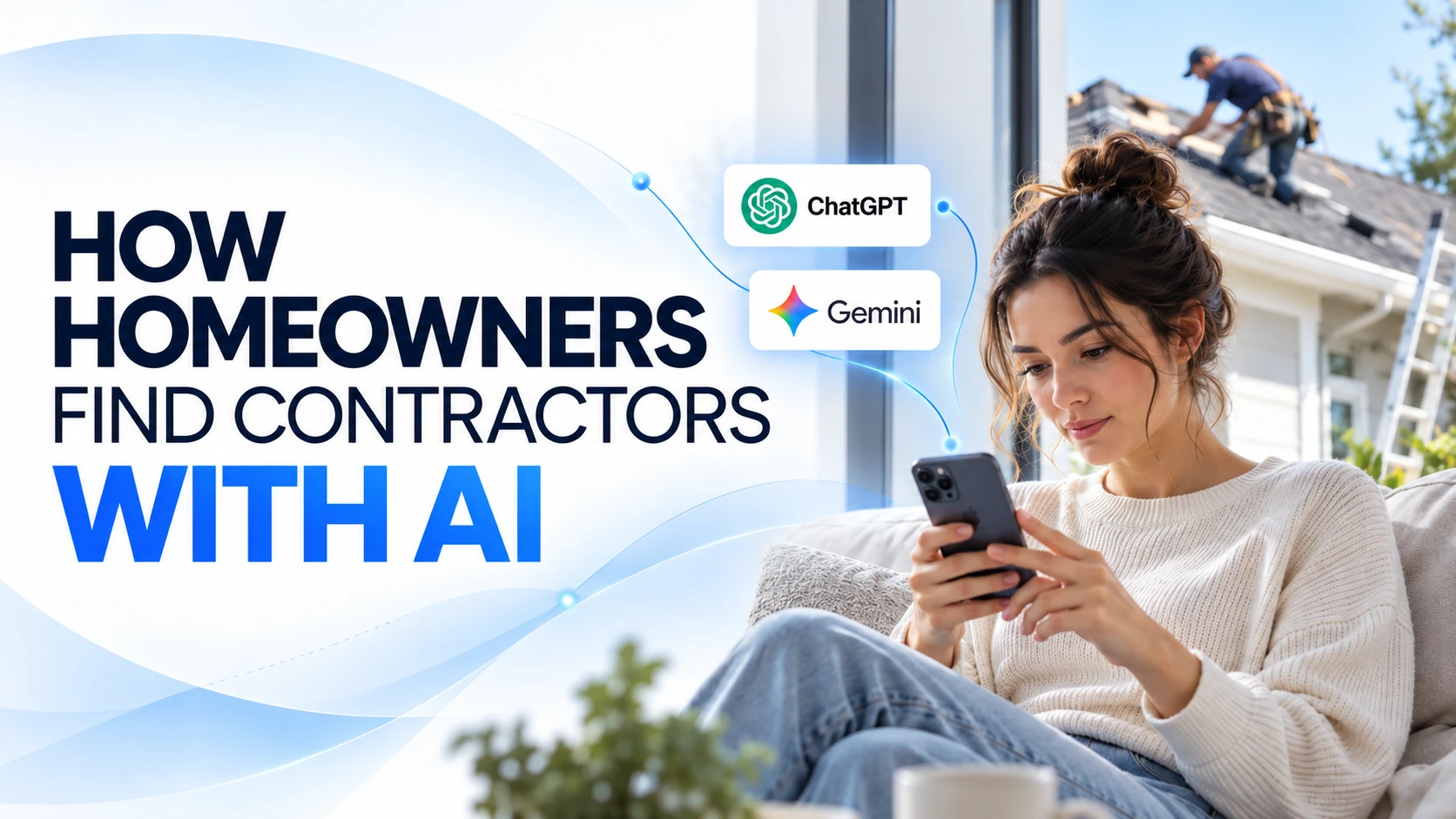
They may ask ChatGPT, Gemini, or Google's AI-powered search features before visiting a contractor's website.
The difference matters.
The homeowner isn't necessarily looking for a roofing company yet. They're trying to understand a problem. The contractor recommendation may come later in the conversation.
And in 2026, home services platforms are building ways to connect those conversations to real contractor inquiries.
For roofing, HVAC, plumbing, remodeling, and other home improvement businesses, this creates a new consideration in lead generation: Will your business be discoverable when a homeowner asks an AI assistant for help? How are homeowners finding contractors through AI? Homeowners can discover contractors through AI-assisted search results, website recommendations, and connected home services applications.
Instead of starting with a specific business name, a homeowner might describe a problem, compare solutions, ask about costs, and then request help finding a qualified local professional.
Consider three examples:
- Roofing: “My roof started leaking after a storm. Should I repair it or replace it?”
- HVAC: “My AC keeps running but isn't cooling the house. Should I call a technician?”
- Bathroom remodeling: “What does a walk-in shower conversion involve, and how do I find someone to install one?”
Each question represents a different stage of homeowner intent.
The first question may need an explanation. The second could indicate an urgent service requirement. The third suggests a homeowner evaluating a larger project.
An AI assistant might provide guidance, cite useful websites, or help the homeowner discover a service provider.
But these experiences don't all work the same way. Three AI discovery paths contractors should understand AI-assisted search. A homeowner receives an AI-generated response with links to supporting websites or business information. A contractor's website may then earn a visit or inquiry.
Connected marketplace apps. A homeowner uses an AI-connected home services platform to explore a project and find professionals. The marketplace may help move the homeowner toward a service request.
AI-supported research. A homeowner researches costs, repairs, and service options before contacting anyone. Helpful content can introduce a contractor earlier in the buying process.
These paths can influence the same eventual decision: which contractor gets contacted.
However, appearing as a cited website is different from being recommended through a connected marketplace. Neither outcome is guaranteed. What changed in 2026? Angi brought contractor discovery into ChatGPT and Gemini One of the clearest developments came from Angi, the U.S. home services marketplace.
On March 4, 2026, Angi announced its app in ChatGPT.
The integration allows homeowners to begin with a home improvement question and move into Angi's project-scoping and contractor-matching experience.
For example, someone researching a roof replacement can receive guidance and move toward connecting with a relevant professional without treating the original conversation as a traditional keyword search.
Then, on August 12, 2026, Angi announced its availability as a connected app in Google's Gemini, beginning August 13.
These announcements matter because they connect two activities that historically occurred across separate stages:
- Understanding a home improvement problem.
- Finding a professional to solve it.
What Angi's early results suggest In its March announcement, Angi reported that users of its AI Helper were:
- Three times more likely to request a quote than traditional browsing users.
- 25% more likely to report successful project completion when they began with AI Helper.
These are Angi-reported comparisons involving its own AI Helper experience. They should not be interpreted as universal conversion benchmarks for ChatGPT, Gemini, or contractor websites.
Still, they raise an important question:
If a homeowner explains their project before requesting a quote, could that produce a more clearly defined service inquiry?
It is a useful hypothesis for lead generation teams to test.
A homeowner who has identified their problem, clarified their project type, and specified their location may be easier to qualify than someone submitting a vague request.
But the answer depends on the actual lead, the information collected, and what happens after the inquiry reaches a contractor.
Sources: Angi's ChatGPT announcement, March 2026 and Angi's Gemini announcement, August 2026. What makes a contractor discoverable in AI search? There is no single setting that guarantees a roofing, HVAC, or remodeling business will appear in an AI-generated recommendation.
Google's guidance for AI Overviews and AI Mode emphasizes the same fundamentals that support traditional Search: technically accessible websites, useful content, clear business information, and a strong user experience.
OpenAI similarly explains that allowing its search crawler to access a website can support eligibility for ChatGPT search, but does not guarantee placement.
For contractors, the practical work starts with making several important facts easy to find and verify.
- Make your services and service areas unmistakably clear
Imagine two HVAC websites.
The first homepage says:
“Your trusted comfort partner. Quality solutions for every season.”
The second explains that the company provides residential AC repair, system replacement, and heating services across its actual service area.
The second gives a homeowner, search engine, or AI-assisted discovery system more useful information.
A contractor's website should clearly explain:
- Which services the company performs.
- Which cities, ZIP codes, or regions it serves.
- Which residential or commercial project types it accepts.
- How customers can contact the company.
- Whether emergency or scheduled appointments are available.
Dedicated service pages can help where the services represent distinct customer needs.
For example, roof replacement, storm damage repair, and roof inspections may justify separate pages when each contains genuinely useful information.
The objective isn't to publish more pages for the sake of volume. It's to explain the business accurately.
- Answer questions homeowners ask before hiring
Traditional local searches often start close to a purchase decision.
AI conversations may begin earlier.
A homeowner might ask whether a damaged roof can be repaired, what causes an AC compressor to fail, or whether a bathroom can be remodeled without moving the plumbing.
That creates an opportunity for contractors to publish information based on their actual experience.
Useful content could include:
For roofing contractors:
- Repair versus replacement considerations.
- Storm damage inspection processes.
- Roof material comparisons.
- Factors affecting project cost.
For HVAC contractors:
- Common causes of cooling failure.
- Repair-or-replace decision factors.
- What happens during an HVAC inspection.
- Questions to ask before installing a new system.
For remodeling contractors:
- Project timelines and preparation.
- Material and layout trade-offs.
- Accessibility considerations.
- Questions to ask during an estimate.
The strongest content doesn't simply repeat generic advice.
It explains the variables that affect a real decision, identifies exceptions, and helps homeowners understand their next step.
Where possible, support explanations with original photographs, project details, and attributable professional expertise.
- Keep your business information accurate
For local contractors, Google Business Profile remains an important part of online discoverability.
Service categories, operating hours, contact information, business location or service areas, and other relevant information should reflect how the business actually operates.
The website should support those details rather than contradict them.
If a contractor serves three counties, the website shouldn't imply nationwide coverage.
If emergency calls are unavailable after business hours, the page shouldn't advertise 24-hour service.
Accurate information isn't merely a search consideration. It also helps avoid inquiries that the business cannot serve.
- Make sure search systems can access the website
A useful page cannot contribute much to organic discovery if it is inaccessible or unintentionally blocked.
For Google's AI search features, normal Search indexing and snippet eligibility remain important.
For ChatGPT search, OpenAI recommends allowing its OAI-SearchBot crawler and ensuring the website's hosting or security infrastructure does not block legitimate crawler traffic.
Contractors should review:
- Important service pages for indexing problems.
- Internal links connecting informational and service pages.
- robots.txt and relevant crawler restrictions.
- Mobile usability and page performance.
- Text availability for critical service information.
No special AI-only schema or llms.txt file is required for inclusion in Google's AI Overviews or AI Mode.
A well-maintained website is a better starting point than an expensive collection of unproven AI search tricks.
Sources: Google Search Central's AI optimization guidance and OpenAI's ChatGPT search guidance. Getting discovered is only half the challenge Suppose a homeowner uses an AI assistant to research a roof replacement.
They find a contractor, visit the website, and submit an inquiry.
At that point, the question changes.
The marketing team no longer needs to know only whether the website appeared in an AI response.
It needs to know whether the inquiry turned into a qualified opportunity.
There is a difference between:
- Someone researching roof replacement costs.
- Someone comparing contractors for a project next year.
- A homeowner requesting a roof inspection this week.
- A homeowner outside the company's service area.
All four people might interact with the same content. They do not represent the same commercial opportunity.
This is where lead qualification, routing, and follow-up become important.
For home improvement businesses, useful qualification information can include the requested service, property location, project timing, relevant eligibility criteria, and contact details, subject to the applicable consent and privacy requirements.
The goal is to give the sales team enough context to determine whether an inquiry is relevant and what should happen next.
More visibility is valuable when it produces better opportunities. Visibility without qualification can simply create more work for the sales team. How should contractors measure AI-driven lead generation? A contractor cannot judge this channel by asking ChatGPT whether its business is recommended once and treating the answer as a ranking report.
AI-generated results may vary by question, location, context, and platform.
A more useful approach is to combine search visibility measurements with actual sales outcomes.
Google announced dedicated Generative AI performance reporting in Search Console in June 2026 and stated that the reports had rolled out globally by August 31.
These reports provide additional visibility into impressions from supported generative AI Search experiences.
Contractors can combine those reports with website analytics and CRM data.
The measurements worth reviewing include:
- AI search impressions: Identify pages appearing in supported Google AI search experiences.
- AI referral traffic: Track visits from identifiable AI-platform referrals.
- Inquiry source: Record where homeowners say they first discovered the contractor.
- Qualified lead rate: Calculate the share of inquiries matching service and location requirements.
- Appointment rate: Track how often qualified inquiries become scheduled appointments.
- Cost per booked job: Evaluate how efficiently each lead source contributes to acquired work.
Not every AI-assisted discovery journey will be identifiable in attribution data.
A homeowner may research with ChatGPT, search the company name on Google the following day, and call directly. Standard analytics might credit that inquiry to branded search or direct traffic rather than the earlier AI interaction.
For that reason, AI referral numbers alone should not be treated as a complete measure of influence.
The business outcome matters more than the visibility screenshot.
Source: Google's Generative AI performance reporting announcement. A practical plan for home service contractors Contractors don't need to abandon Google Ads, referrals, local SEO, or other working acquisition channels.
AI-assisted discovery should be evaluated as another potential entry point into the homeowner journey.
A practical starting plan involves four priorities.
First, review your highest-value service pages. Make sure each page accurately explains the service, geographic coverage, customer problem, and next step.
Second, identify the questions that precede your best jobs. Ask the sales team what homeowners frequently want to understand before scheduling. Turn those questions into genuinely useful content.
Third, test how your business appears in AI-assisted discovery. Use a consistent set of relevant prompts and locations, record whether the business or its content appears, and note the sources cited. Treat this as directional monitoring rather than an official ranking system.
Fourth, connect discovery data to your lead pipeline. Track relevant referrals, qualified inquiries, booked appointments, and downstream outcomes. Compare results with established acquisition channels before reallocating resources.
A contractor whose website is easy to find but whose sales team responds too slowly may need a follow-up improvement more urgently than another blog post.
Likewise, a contractor receiving inquiries outside its territory may need better targeting and qualification rather than more traffic.
The strongest acquisition strategy addresses the entire path from homeowner intent to a completed job. Where does IntelHouse fit into this changing landscape? AI-assisted search is changing how homeowners can begin their research.
But contractors still need reliable ways to attract and qualify homeowner demand.
IntelHouse approaches that challenge through in-house performance marketing, buyer-specific qualification, and real-time lead delivery.
Its home improvement campaigns support service categories including roofing, HVAC, windows, siding, and remodeling.
Under IntelHouse's approved distribution rules, a qualified homeowner inquiry is matched and delivered to one buyer. Lead routing can be configured around the contractor's territory, project types, operating hours, and other campaign requirements.
That model addresses a separate but important part of the acquisition process: turning homeowner interest into an opportunity that reaches the right sales team.
AI search visibility and exclusive lead generation are not interchangeable. One concerns how a homeowner discovers options. The other concerns how qualified demand is acquired, distributed, and handled.
For contractors building a more resilient pipeline, both questions deserve attention.
Explore IntelHouse's exclusive home improvement lead generation or learn how IntelHouse qualifies and delivers leads. Frequently asked questions Can ChatGPT recommend local contractors? Yes. ChatGPT search can help users discover businesses and relevant websites. A business appearing in the results depends on the request, available information, and search systems. No contractor is guaranteed placement. Can homeowners find contractors through Gemini? Yes. Google's AI-powered experiences can support research and discovery, and connected applications may enable more specific service journeys. Angi announced its Gemini connected app in August 2026, allowing homeowners to move from project-related questions toward connecting with professionals through Angi. How do contractors improve their visibility in AI search? Start with clear service pages, accurate local business information, accessible website content, useful answers to homeowner questions, and credible evidence of experience. These practices support search discoverability, but do not guarantee AI citations or recommendations. Is AI search replacing Google Ads and traditional contractor lead generation? There is no basis for assuming AI search will replace those channels. Contractors should evaluate AI-assisted discovery alongside existing channels using qualified inquiries, appointment rates, customer acquisition costs, and actual business results. Do contractors need special AI SEO software? Not necessarily. Google's official guidance does not require special markup or AI-specific files for its generative search features. Contractors should resolve technical and content problems before purchasing additional optimization tools. Can contractors track leads that originated from ChatGPT or Gemini? Some visits can be identified through referral data, analytics, and CRM attribution. However, not every AI-assisted research journey is directly measurable, particularly when a homeowner returns through another channel. Combining analytics with lead-source questions and sales outcomes provides a more useful picture. The next homeowner inquiry may begin with a conversation A homeowner asking an AI assistant about a leaking roof isn't necessarily ready to hire someone.
But they have started looking for an answer.
As AI-connected home services experiences develop, the journey from identifying a problem to finding a contractor may involve fewer separate searches and more guided questions.
For contractors, the priority isn't to chase every new AI feature.
It's to make their business easy to understand, their expertise useful to homeowners, and their acquisition process capable of turning relevant demand into booked work.
Because whether the first interaction happens through Google, ChatGPT, Gemini, or another channel, the commercial question remains the same:
Did the right homeowner reach the right contractor at the right time?
Book a Lead Flow Review with IntelHouse References
- Angi Launches the Angi App in ChatGPT, March 4, 2026
- Angi Announces Its Gemini Connected App, August 12, 2026
- Google Search Central: Optimizing for Generative AI Features
- Google Search Central: AI Features and Your Website
- Google: Generative AI Performance Reports in Search Console, June 2026
- OpenAI: Searching the Web With ChatGPT