Google Local Services Ads Are Moving to Performance Max: What Home-Service Lead Buyers Need to Know
Google is changing how Local Services Ads (LSAs) are managed.
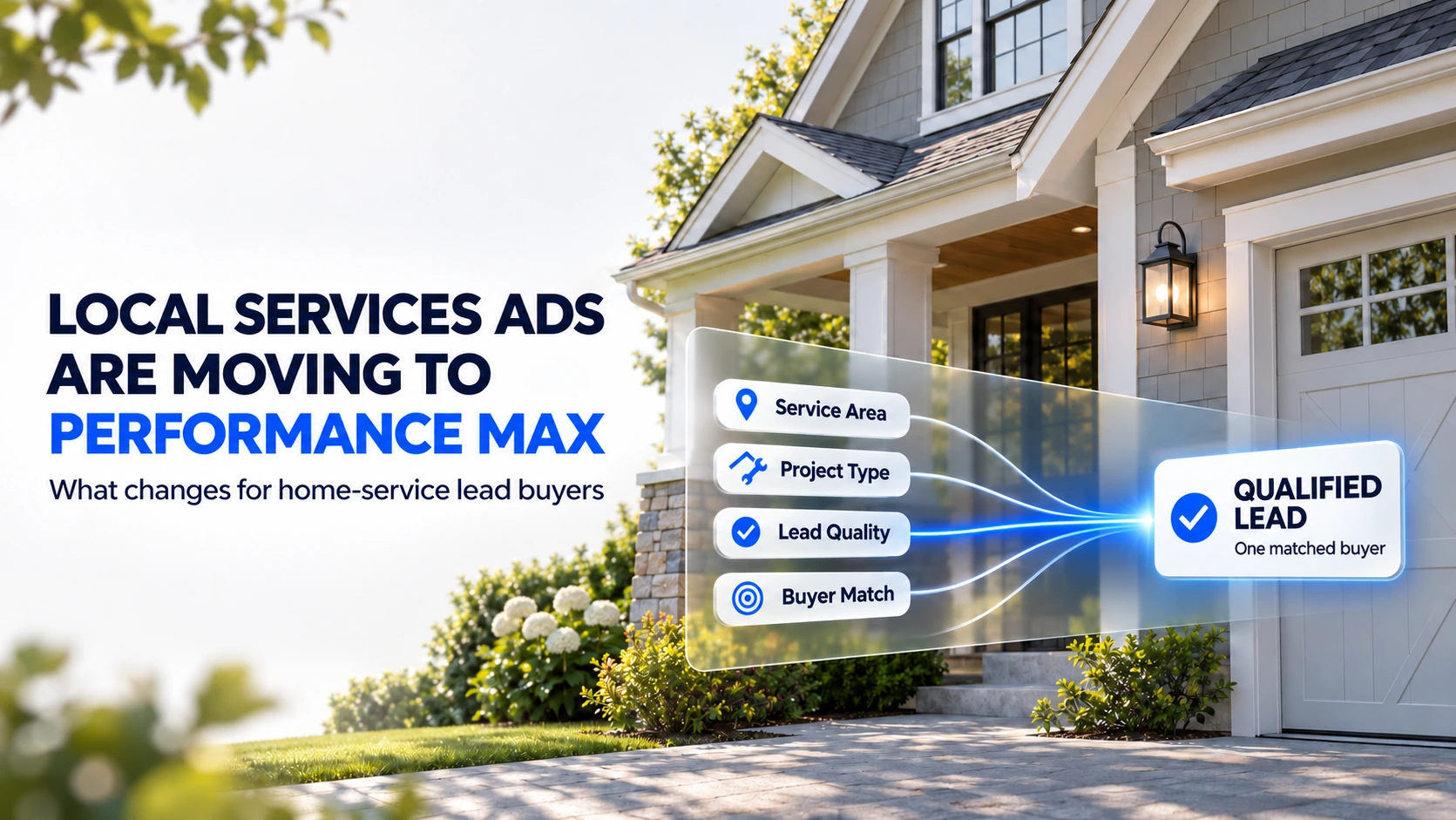
The company is migrating existing Local Services Ads campaigns into a specialized version of Performance Max with pay-per-lead goals. The rollout began with selected US service advertisers in August 2026 and is expanding in phases.
For HVAC, roofing, plumbing, electrical, and other home-service businesses, this is a meaningful operational change.
But for companies buying home-improvement leads, the bigger question isn't simply where the campaigns will live.
It's whether the leads being generated are turning into qualified conversations, booked appointments, and completed jobs.
A lead can meet Google's billing criteria and still fail to produce revenue for a home-service business.
That distinction matters more when campaign management becomes increasingly automated.
What Is Changing With Google Local Services Ads?
Google is moving Local Services Ads management into the Google Ads platform through a specialized Performance Max campaign type designed for pay-per-lead advertising.
Unlike standard Performance Max campaigns, these campaigns continue to focus on local customer inquiries.
According to Google's official documentation:
Advertisers continue paying for valid leads, rather than ordinary ad clicks.
Ads continue appearing on Google Search and Google Maps.
Campaigns remain keywordless, using service categories, business information, and geographic targeting.
Budgets, bidding settings, targeting, and customer inquiries move into Google Ads.
Historical Local Services Ads performance reports do not automatically transfer.
Manual bidding and vertical-level target CPA controls are being deprecated.
Importantly, this is not the same as moving every Local Services Ad into a traditional, all-channel Performance Max campaign.
The pay-per-lead version has different billing rules, placements, and supported features.
Google's official migration documentation:
https://support.google.com/google-ads/answer/17213585
When Is the LSA to Performance Max Migration Happening?
Google has outlined a phased rollout.
August 2026: Initial US Rollout
The first phase began for selected home-service and storefront-service advertisers in the United States.
The initial group included categories such as:
HVAC
Plumbing
Electrical services
Roofing
Appliance repair
House cleaning
Lawn care
Pest control
Moving services
Late 2026: Broader Expansion
Google's documented rollout expands to additional advertisers, including service-area businesses without storefronts and accounts using custom bidding or booking configurations.
2027: Remaining Categories and International Accounts
Google plans to migrate remaining advertiser categories and non-US accounts during 2027.
What this means: Not every Local Services Ads account is migrating on the same date.
Google says account administrators receive advance migration notifications. Businesses should review the notification and prepare their reporting before their scheduled transition.
This is an ongoing rollout, not a single platform-wide switch.
- Automated Bidding Changes How Advertisers Manage Lead Costs
One of the most important operational changes involves bidding.
Google is deprecating manual bidding for migrated campaigns, including manually setting a maximum cost per lead. It is also removing separate vertical-level target CPA settings within a single campaign.
Advertisers can still manage campaign-level bidding targets through supported automated strategies.
For businesses advertising across multiple service categories, that distinction matters.
A plumbing repair inquiry and a major HVAC installation opportunity can have very different revenue potential.
Yet their value cannot be understood through cost per lead alone.
The Lead Buyer's Perspective
Imagine two lead sources.
Source A delivers a larger number of relatively inexpensive inquiries.
Source B delivers fewer inquiries but a higher proportion of qualified appointments.
If a business evaluates both sources only by cost per lead, Source A may appear more attractive.
But if Source B produces more profitable completed jobs, the conclusion changes.
The practical lesson is simple:
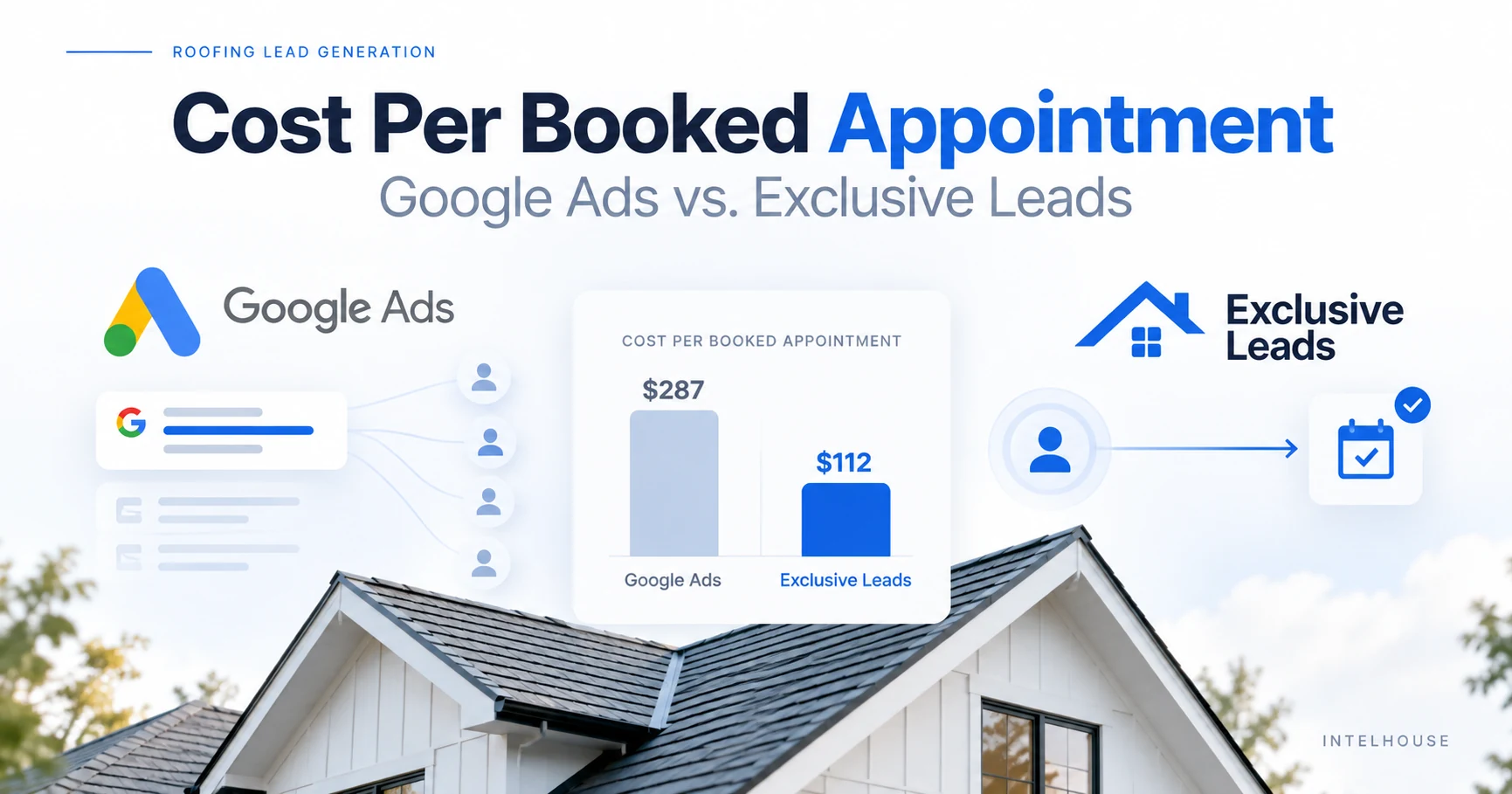
Cost per lead measures acquisition expense. Cost per booked appointment and cost per won job reveal more about commercial performance.
For home-service lead buyers, the important metrics include:
Cost per received lead
Percentage of leads accepted after qualification
Contact rate
Appointment-set rate
Appointment-show rate
Job close rate
Cost per won job
Not all these metrics are supplied by Google's campaign dashboard. Many require accurate CRM dispositions and buyer-side sales tracking.
That is why platform reporting and sales reporting need to work together.
- Automated Lead Reviews Are Not the Same as Buyer Qualification
Google uses automated systems to assess lead validity and determine whether certain leads qualify for credits.
Its pay-per-lead documentation describes lead billing statuses such as charged, not charged, in review, and credited.
Google also explains that manual lead disputes are no longer supported for the migrated campaign type.
These systems help advertisers manage billing validity.
However, Google's definition of a chargeable lead is not identical to an individual buyer's definition of a commercially valuable lead.
Consider a roofing inquiry.
A homeowner contacts an advertiser about a roof repair.
The inquiry may satisfy the platform's billing requirements.
But the receiving business may discover that:
The homeowner is outside its actual service area.
The project does not match its accepted job types.
The customer needs a service the business cannot provide.
The project timeline does not fit current capacity.
The customer cannot be reached after the inquiry.
These are buyer-level qualification and operational issues.
They should not automatically be treated as grounds for a Google billing credit.
What Lead Buyers Should Check
Every lead-buying operation should have clear acceptance criteria.
At minimum, those criteria should define:
Service category and job-type fit.
ZIP-code or geographic coverage.
Customer contactability.
Project intent and relevant timing.
Buyer capacity and routing eligibility.
Final sales disposition.
The objective is not simply to receive more inquiries.
It is to direct suitable inquiries to buyers who can realistically convert them.
Google's documentation on lead billing and automatic credits:
https://support.google.com/google-ads/answer/18550592
- Historical Local Services Ads Reports Will Not Transfer
This is one of the most actionable parts of the migration.
Google explicitly states that historical Local Services Ads campaign performance reports will not transfer into Google Ads.
Past customer lead history is treated differently: Google says existing customer leads, including certain conversation histories and recordings, will transfer.
That means lead history transferring does not mean old campaign reporting transfers.
What Advertisers Should Preserve
Before migration, retain the historical data available to your account, including:
Advertising spend
Lead volume
Cost per lead
Performance by time period
Service categories
Geographic targeting
Campaign settings
Available lead outcomes and relevant CRM records
Google's documentation indicates that a dedicated historical-report download option is being introduced. Where an export is not yet available, Google recommends capturing the relevant reports before migration.
Why does this matter?
Because historical data provides context.
Without a baseline, a business may struggle to determine whether post-migration performance changes reflect:
Advertising costs
Seasonal demand
Lead-quality differences
Routing changes
Contact-center performance
Sales conversion rates
A clean historical record makes future comparisons more useful.
- More Automation Makes Lead Routing and CRM Feedback More Important
A campaign can generate a relevant inquiry and still lose the opportunity after delivery.
This is where lead buyers need to look beyond the advertising platform.
The path from acquisition to revenue typically includes:
Lead source → Qualification → Buyer selection → Routing → First contact → Appointment → Sales outcome
Each stage introduces a potential failure point.
Example: The Lead Arrives, but Nobody Calls
An HVAC inquiry comes in during a busy period.
The lead reaches a CRM, but the correct team does not receive it immediately.
By the time someone follows up, the homeowner may already be speaking with another contractor.
The advertising campaign generated an inquiry.
The operational process failed to convert the opportunity.
This is why response time, routing accuracy, and disposition tracking deserve as much attention as acquisition metrics.
The CRM Problem
If every lead ends with the disposition "Lead received," the business has little visibility into what happened next.
A more useful system distinguishes:
Received
Accepted
Rejected, with reason
Contact attempted
Contacted
Appointment set
Appointment completed
Estimate issued
Job won
Job lost, with reason
These stages make it possible to compare sources based on downstream outcomes.
For a lead-generation partner, that feedback can guide qualification, source selection, and buyer matching.
- What Should US Home-Service Lead Buyers Do Now?
The LSA migration presents an opportunity to review the entire lead acquisition process.
Here is a practical checklist.
Check 1: Confirm Campaign and Service-Area Settings
Advertisers undergoing migration should confirm that transferred service categories, locations, schedules, and budget settings match their business requirements.
Lead buyers should independently verify that incoming inquiries meet their own coverage and acceptance rules.
Check 2: Preserve Historical Reporting
Save available Local Services Ads performance data before the account migrates.
Maintain a dated baseline so pre- and post-migration performance can be evaluated without relying on memory.
Check 3: Separate Billing Validity From Buyer Quality
A platform-chargeable lead may still fail buyer-specific qualification.
Track these as separate concepts, with clear disposition reasons.
Check 4: Review Lead Delivery and Contact Speed
Measure how long it takes an inquiry to move from receipt to assignment and first contact.
Investigate delays, missed notifications, incorrect routing, and after-hours handling.
Check 5: Report on Revenue-Related Outcomes
Evaluate lead sources against appointments and completed jobs wherever reliable data is available.
Do not assume that lower CPL automatically means better acquisition economics.
What Does the Migration Mean for Lead-Generation Companies?
For lead-generation businesses, the important strategic change is not that every source must now use Performance Max.
It is that one of Google's major local advertising products is moving further toward automated campaign management.
The competitive advantage for lead suppliers and buyers increasingly depends on what happens outside the platform:
Clear qualification standards
Geographic and service-category matching
Reliable exclusive-lead delivery
Responsive buyer operations
Source-level reporting
Feedback from sales outcomes
A lead-generation system should help answer a practical question:
Which sources, lead types, and buyer routes produce opportunities that turn into real business?
That is a more useful conversation than simply asking how many leads were delivered.
How IntelHouse Approaches Home-Service Lead Generation
IntelHouse works with businesses buying leads across home-improvement and other lead-generation markets.
Our model focuses on exclusive, real-time web leads and calls, with one buyer assigned to each lead.
The approach emphasizes owned acquisition campaigns, buyer-specific qualification, lead delivery, and source-level visibility.
For home-service lead buyers, this creates an opportunity to evaluate incoming demand against actual business requirements rather than relying on volume alone.
The aim is straightforward:
Better-aligned leads, clearer delivery, and more useful feedback on what happens after acquisition.
Campaign volume is only one part of that equation.
Request an IntelHouse Lead Flow Review
Google's Local Services Ads migration is a useful reminder to evaluate the entire customer acquisition process.
Before adding more lead volume, it is worth understanding where existing opportunities are being lost.
An IntelHouse Lead Flow Review can help frame a conversation around:
Lead sources and acquisition requirements
Service-area and project qualification
Buyer matching and routing
Delivery and follow-up processes
CRM dispositions and outcome visibility
If your team buys HVAC, roofing, plumbing, electrical, or other home-improvement leads in the United States, let's examine how your current lead flow is structured.
Request a Lead Flow Review with IntelHouse.
Visit https://intelhouse.net to get started.
Frequently Asked Questions
Is Google replacing Local Services Ads with Performance Max?
Google is migrating existing Local Services Ads campaigns into a specialized Performance Max campaign type with pay-per-lead goals. The rollout is phased and differs from standard, all-channel Performance Max advertising.
Will Local Services Ads still charge per lead?
Yes. Google's specialized Performance Max campaigns with pay-per-lead goals continue charging for valid customer inquiries rather than standard ad clicks.
Will these ads appear on YouTube and the Display Network?
No. Google states that the specialized pay-per-lead campaigns continue serving on Google Search and Google Maps. This is different from standard Performance Max campaigns.
Will historical LSA reports transfer to Google Ads?
No. Google says historical campaign performance reports will not automatically transfer. Advertisers should preserve relevant reports before migration. Past customer lead history is handled separately and is expected to transfer.
Can advertisers still manually dispute leads?
Google states that manual lead disputes are no longer supported for these campaigns. Automated lead-quality reviews and credits remain part of the billing process.
When will my Local Services Ads account migrate?
The first US rollout began in August 2026, with broader migration during late 2026. Remaining categories and non-US accounts are scheduled for 2027. Google notifies account administrators ahead of their individual migration dates.
Does a Google-chargeable lead mean it is qualified for my business?
Not necessarily. Google's billing criteria and a buyer's commercial acceptance criteria serve different purposes. Buyers should independently evaluate service-area fit, job type, customer intent, routing, and sales outcomes.
What metrics should home-service lead buyers track?
Beyond lead volume and CPL, buyers should monitor accepted-lead rate, contact rate, appointment-set rate, appointment-show rate, close rate, and cost per won job. These measurements usually require CRM and sales-outcome data.
Official Sources
Google Ads Help — Local Services Ads transition to Performance Max campaigns with pay-per-lead goals https://support.google.com/google-ads/answer/17213585
Google Ads Help — Lead quality and budgets for campaigns with pay-per-lead goals https://support.google.com/google-ads/answer/17326057
Google Ads Help — How leads work in Performance Max campaigns with pay-per-lead goals https://support.google.com/google-ads/answer/18550592
Information reviewed November 16, 2026. Google may update rollout schedules, account settings, and feature availability. Advertisers should confirm details within their own Google Ads account.