Google AI Mode is changing how homeowners find and book contractors.
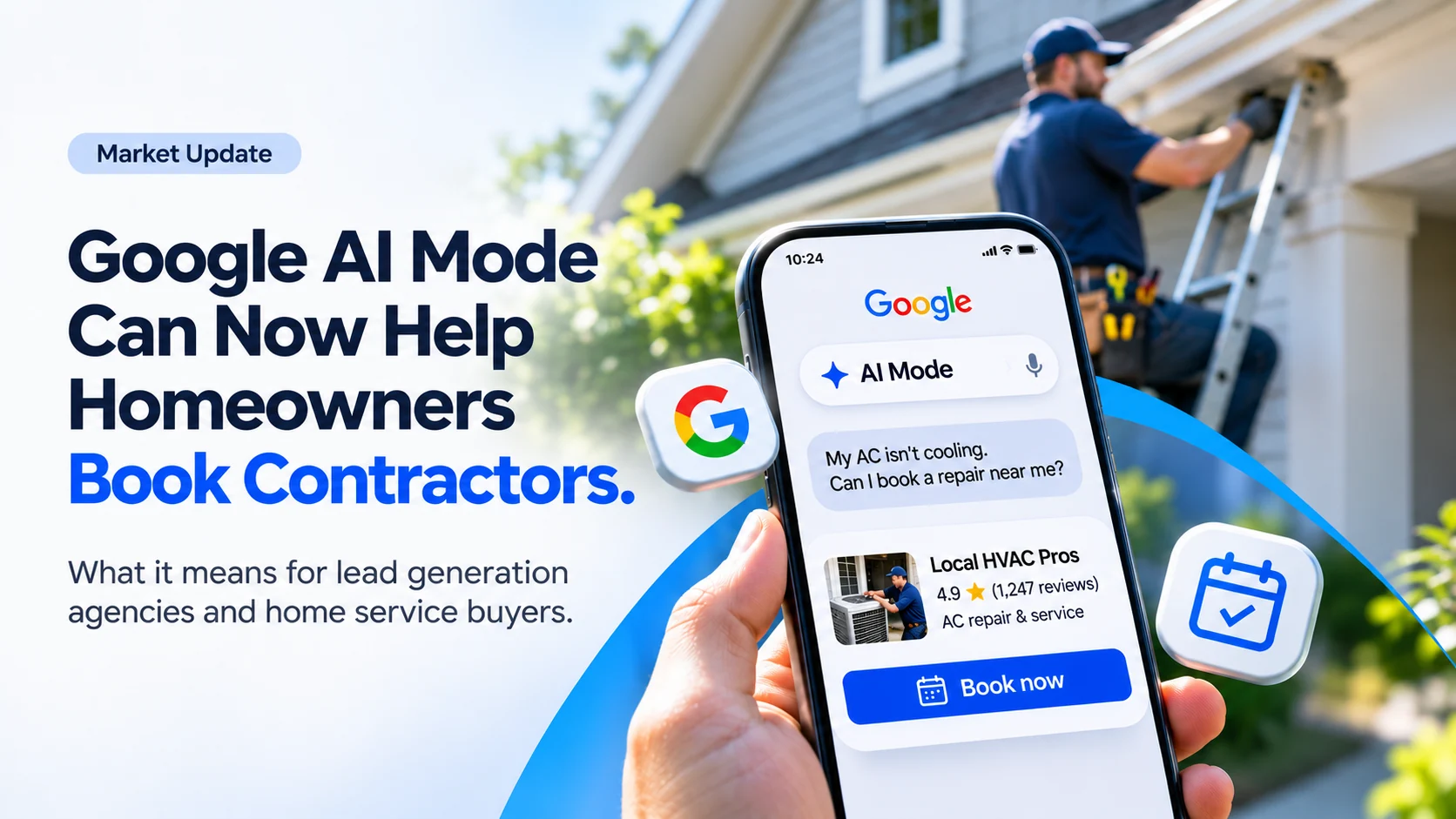
A homeowner with a broken air conditioner can now describe the problem to Google's AI-powered search, explore relevant local service providers, and move toward requesting a quote or booking a service.
That matters for contractors. But it might matter even more for the companies generating and buying home improvement leads.
On November 4, 2026, Google announced new home-service booking and quote links in AI Mode through partners including Angi, Thumbtack, Housecall Pro, and Jobber. ServiceTitan was also identified as an upcoming partner.
If Google can move homeowners from searching to requesting a contractor, what happens to traditional lead generation?
The answer isn't that lead generation agencies suddenly become unnecessary.
It's that knowing where a lead came from, whether it matches the buyer, and what happens after delivery becomes increasingly important.
What changed with Google AI Mode?
Google AI Mode now connects certain US home-service searches to booking and quote-request experiences through participating service platforms.
Previously, a homeowner might search for an HVAC contractor, visit several websites, compare reviews, submit an enquiry form, and wait for a response.
Now, another journey is possible.
Imagine a homeowner asking:
"My AC stopped cooling. Who can repair it near me this week?"
AI Mode can help the homeowner explore relevant professionals and access booking or quote-request options.
The specific experience depends on the platform, available contractors, and how the service request is handled.
Which home-service platforms are involved?
Google named several partners in its November 4 announcement.
Jobber: Eligible US businesses with active paid subscriptions can connect their request or booking forms. Jobber states that requests originating through Google AI Mode do not incur lead fees.
Housecall Pro: Its integration connects AI-assisted service requests with the provider's Job Inbox, using information including service area, reviews, and availability. The company also advertises no associated lead fees. Its initial announcement described the integration as coming soon to eligible US customers, while newer product documentation describes the functionality as available.
Angi: Homeowners can be directed to participating contractor profiles where they can request quotes.
Thumbtack: Google identified Thumbtack as a booking partner.
ServiceTitan: Google announced ServiceTitan as an upcoming integration.
These partnerships represent a new discovery and booking route, but they don't mean every contractor is automatically guaranteed visibility.
Google has not disclosed a complete ranking formula for these recommendations.
For contractors and lead buyers, that's an important distinction.
Why does this matter for home-service lead generation?
The traditional acquisition journey often follows a familiar sequence:
A homeowner searches for a contractor.
The homeowner discovers an advertisement, listing, or website.
They submit an enquiry or call.
A contractor or sales team follows up.
The business attempts to schedule, estimate, and close the job.
AI-assisted discovery could shorten parts of that journey.
Instead of visiting several websites before contacting a business, a homeowner may be able to move more directly toward a service request.
But there's an important detail.
A service request isn't automatically a qualified lead. And a qualified lead isn't automatically a won job.
The business still needs to understand the homeowner's requirements, location, timing, project type, and ability to proceed.
A contractor may receive an enquiry for a service they don't offer or a property outside their operating area.
The homeowner may want an emergency repair when the business is focused on replacement projects.
Or the request may be relevant, but the team might not have the capacity to respond quickly.
The new booking experience may reduce discovery friction.
It doesn't eliminate the need for qualification, routing, follow-up, and sales execution.
Free AI Mode leads sound attractive. Why would contractors still buy leads?
Jobber and Housecall Pro describe their Google AI Mode integrations as having no associated lead fees for eligible users.
That creates an interesting question.
If contractors can receive enquiries without paying a fee for each request, why would they continue paying for lead generation?
Because the fee associated with receiving an individual enquiry is only one part of acquisition economics.
A no-lead-fee request doesn't guarantee consistent monthly volume.
It doesn't guarantee a homeowner is inside the right territory.
And it doesn't guarantee the project matches what a contractor is trying to sell.
Consider an HVAC business expanding its replacement division.
It may be happy to receive additional service enquiries through AI search.
But its commercial priority might be generating qualified replacement enquiries in specific ZIP codes.
A dedicated acquisition campaign can be structured around that target.
The business might need controlled geographic targeting, specific project categories, qualification criteria, and a consistent lead-delivery process.
These are different acquisition models.
One can help a homeowner discover an available contractor.
The other can be designed around a buyer's specific demand-generation requirements.
The most useful question isn't whether a lead is free or paid. It's whether the opportunity is relevant, actionable, and economically worthwhile.
Will Google AI Mode replace lead generation agencies?
Not necessarily.
But it creates pressure for agencies whose only value is collecting homeowner contact information and forwarding it to contractors.
If search platforms make it easier to contact service providers directly, basic enquiry collection may become harder to differentiate.
Agencies that provide controlled demand generation, qualification, exclusive distribution, and performance visibility have a broader role.
There are five areas where that distinction matters.
- Generating demand for specific projects
Not every contractor wants more of every type of job.
A roofing business may want full roof replacements rather than minor repairs.
An HVAC company may prioritize system installations.
A remodeling contractor may need kitchen renovation enquiries in specific neighborhoods.
Campaigns built around these requirements can support a more focused acquisition strategy.
- Qualifying enquiries against buyer requirements
A homeowner can be interested in booking a contractor and still be the wrong fit for a particular buyer.
Qualification can consider service area, property details, project category, timing, and other agreed acceptance criteria.
This matters when lead buyers manage different markets, services, or contractor networks.
- Controlling lead distribution
Lead buyers need to know how enquiries are generated, matched, and delivered.
For exclusive lead programs, that includes whether a qualified enquiry is distributed to one approved buyer or shared across multiple competing businesses.
Clear distribution rules help establish what the buyer is actually purchasing.
- Tracking what happens after delivery
An enquiry received is only the beginning.
Did the sales team contact the homeowner?
Was an appointment scheduled?
Did an estimator visit?
Was the project won?
Without those answers, agencies and contractors are making acquisition decisions with incomplete information.
- Avoiding dependence on one discovery channel
Google AI Mode adds another potential source of homeowner demand.
But search platforms, partner eligibility, advertising costs, and customer behavior can change.
A diversified acquisition strategy gives businesses more flexibility than relying entirely on one platform or booking experience.
The strongest lead generation operations may be those that can manage demand across channels while maintaining clear buyer criteria and measurable sales outcomes.
The next challenge: Knowing where your best customers came from
AI-assisted search introduces another layer to marketing attribution.
A homeowner might discover a contractor through Google AI Mode, return later through a branded search, and eventually schedule an appointment from the company's website.
Without proper tracking, the business may struggle to understand how the customer originally discovered it.
Contractors and lead generation agencies should preserve source information whenever it is available.
At minimum, they should monitor:
Lead source: Which platform or campaign generated the enquiry?
Lead acceptance: Did the enquiry meet the agreed qualification criteria?
Contact outcome: Was the homeowner successfully reached?
Appointment outcome: Was an inspection, consultation, or estimate scheduled?
Sales outcome: Was the job won, lost, or still pending?
Acquisition cost: What did the opportunity cost to generate through paid acquisition channels?
These measurements help businesses compare different channels based on real commercial outcomes.
Housecall Pro, for example, documents Google AI as an identifiable lead source inside its Job Inbox.
That makes it possible to distinguish these requests from other channels within the platform.
New discovery channels deserve their own measurement.
Otherwise, businesses risk optimizing for enquiry volume without understanding which sources actually produce valuable projects.
What should home-service contractors do now?
Google's update is worth paying attention to.
But contractors don't need to rebuild their entire marketing strategy around it without first reviewing their systems and the results they receive.
Here are five practical steps.
- Check your booking software eligibility
If you use Jobber, Housecall Pro, or another participating platform, review the latest integration requirements.
For Jobber, eligibility includes an active paid US account and specific business-profile and form configuration requirements.
Different platforms may have different setup processes.
- Review your business information
Make sure your service areas, business address, contact details, and service categories are accurate.
Where relevant, verify your connected Google Business Profile and scheduling information.
Inaccurate business details can create unnecessary friction during discovery and booking.
- Test your booking and notification process
An enquiry is only useful if it reaches the business.
Review how booking requests appear in your software, whether notifications are functioning, and how quickly the appropriate team can respond.
- Identify AI-originated enquiries separately
Where your software provides the information, distinguish AI Mode requests from Google Ads, Local Services Ads, organic search, and other acquisition channels.
Preserve that information in your CRM and reporting systems.
- Measure the complete lead-to-job journey
Don't stop reporting when an enquiry arrives.
Track successful contact, scheduled appointments, completed estimates, and closed jobs.
That is how you begin understanding whether the new channel is commercially useful.
Where IntelHouse fits into this changing market
At IntelHouse, our approach is built around a straightforward principle:
One lead. One buyer.
We operate in-house paid media campaigns and controlled acquisition funnels designed to generate homeowner enquiries for home improvement and home service buyers.
Our process focuses on matching the right enquiries with the right buyers based on agreed requirements.
For exclusive lead programs, an approved homeowner enquiry is delivered to one matched buyer under the agreed distribution rules.
That is different from relying exclusively on a contractor appearing in an AI-generated recommendation.
Our focus is on controlled acquisition, buyer fit, qualification, real-time lead delivery, and source-level visibility.
Google AI Mode is not an IntelHouse integration, and we're not claiming otherwise.
It represents another way homeowners may discover and contact service providers.
IntelHouse operates a separate acquisition model for businesses that want qualified homeowner demand aligned with their specific buying requirements.
For lead generation agencies, contractor networks, and larger buyers, the distinction matters.
The future of home-service lead generation is about more than clicks
Google's AI Mode booking integrations are a meaningful development.
They show how the homeowner journey is evolving from searching for information toward taking action.
What remains uncertain is how much volume these integrations will generate, which providers will receive the most visibility, and how their commercial performance will compare with established acquisition channels.
Those are questions that need real data.
For contractors, the priority should be making their businesses discoverable, keeping their booking systems reliable, and measuring what happens after each request.
For agencies and lead buyers, the opportunity is to provide more value than an enquiry form.
That means understanding buyer requirements, qualifying demand, controlling delivery, and using sales feedback to improve acquisition.
Getting a homeowner's attention is valuable. Turning that interest into the right sales opportunity is what makes lead generation work.
Want more control over your home improvement lead flow?
Buying home improvement leads or managing a contractor network?
Before increasing your next acquisition budget, it may be worth reviewing the fundamentals.
Which project types are you trying to generate?
Which service areas matter most?
What qualifies as an acceptable lead?
And what happens after your sales team receives it?
IntelHouse works with home improvement and home-service lead buyers to develop acquisition programs built around specific buyer requirements and exclusive lead delivery.
Book Your Lead Flow Review with IntelHouse
Tell us what you're trying to generate, qualify, or scale.
Frequently Asked Questions
Can homeowners book contractors through Google AI Mode?
Yes. Google announced new home-service booking and quote links in AI Mode for US users on November 4, 2026, through participating partners including Angi, Thumbtack, Jobber, and Housecall Pro. Specific capabilities and availability depend on the platform.
Does Google AI Mode charge contractors for leads?
Jobber and Housecall Pro state that their integrations do not charge lead fees for eligible requests. That does not establish the pricing terms of every participating platform.
Will Google AI Mode replace Local Services Ads?
Google has not announced that these integrations replace Local Services Ads. They represent a separate way for homeowners to discover and request services.
How can contractors appear in Google AI Mode?
Requirements depend on the platform. Jobber specifies an active paid US account, accurate business details, connected Google Business Profile, and an appropriate booking or request form. Meeting eligibility requirements does not guarantee visibility.
Are AI Mode bookings the same as qualified leads?
Not necessarily. Qualification still depends on the homeowner's project, service area, timing, and the contractor's acceptance criteria.
What are exclusive home improvement leads?
Exclusive home improvement leads are homeowner enquiries generated and distributed under rules that assign an approved lead to one buyer rather than selling the same enquiry to multiple competing buyers.
How should contractors track AI-generated leads?
Where the platform provides source information, businesses should identify AI-originated requests and measure their progression through contact, appointment, estimate, and final sales outcome.
Sources and further reading
Google AI Mode Adds Home Services Booking Links, Search Engine Land, November 4, 2026
Jobber and Google AI Mode Integration, Jobber Help Center
Housecall Pro Integrates with AI Mode in Google Search, November 4, 2026
Housecall Pro: Job Inbox Integration with Google AI
Google Search Central: AI Features and Your Website