Home improvement companies can buy marketing in two common ways: pay for a defined lead outcome or hire an agency to manage campaigns for a recurring fee. Both models can work, but they place cost, control, and performance risk in different hands.
The best choice is the one that produces profitable appointments and jobs—not simply the lowest headline price.
How the Cost-per-Lead Model Works
In a cost-per-lead (CPL) program, the contractor pays an agreed price for each lead that meets the provider’s delivery criteria. Those criteria may include service type, location, contact information, homeowner status, and consent requirements.
This model makes acquisition costs easier to forecast. If a contractor wants 100 leads at a fixed price, the expected media cost is clear. It can also help a company enter a new market without first building campaigns, landing pages, and a media-buying operation.
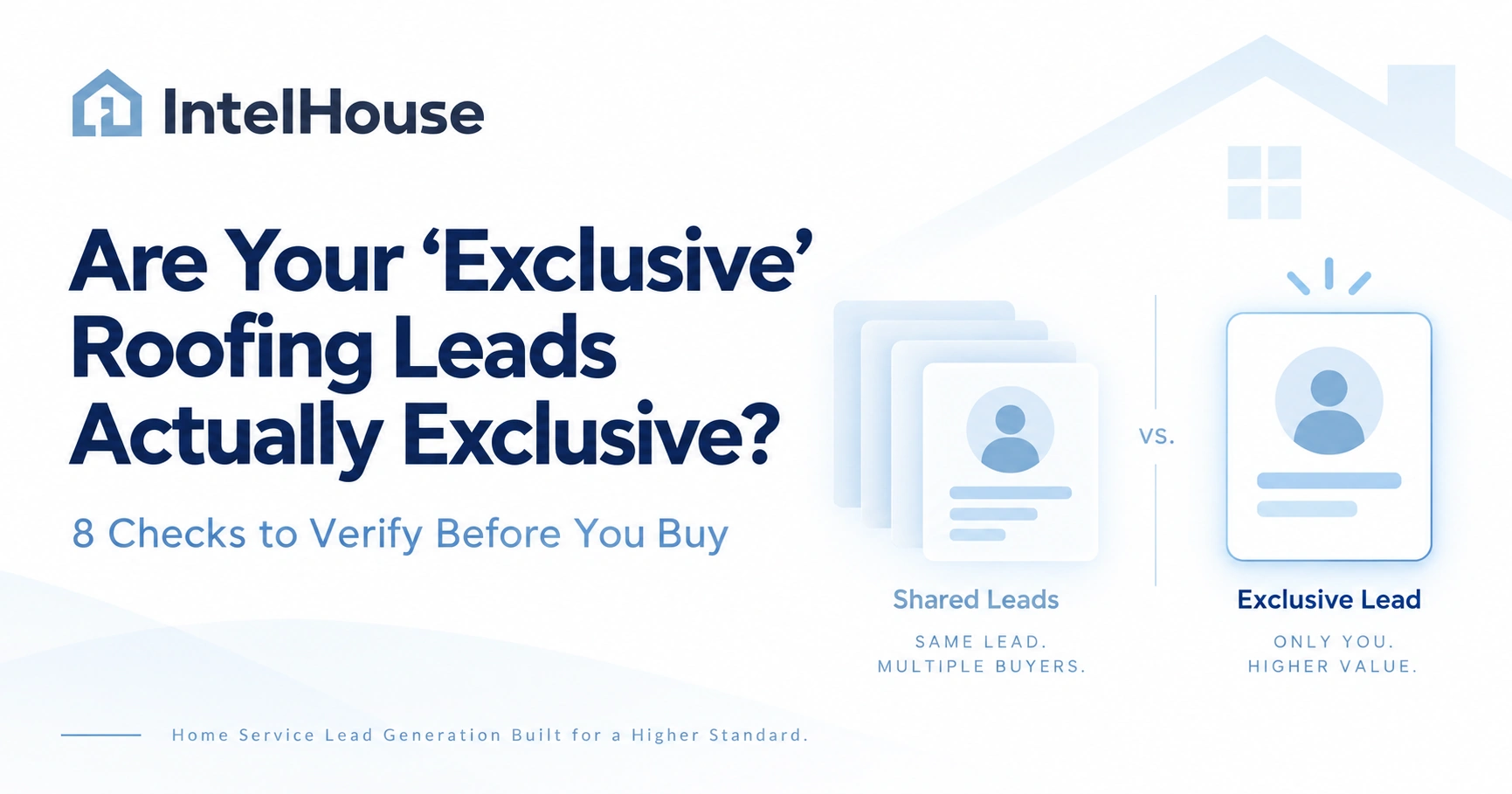
The trade-off is control. The lead provider usually controls the advertising sources and funnel. Contractors should understand whether leads are exclusive or shared, how invalid leads are handled, and what information proves consumer consent.
How an Agency Retainer Works
A traditional agency typically charges a monthly management fee, a percentage of media spend, or both. The client also funds advertising directly. The agency may manage strategy, creative, landing pages, tracking, and optimization.
This structure gives the contractor more visibility into campaigns and assets. It is useful for companies investing in their own brand and willing to tolerate a learning period while campaigns are tested.
The risk is that fees continue even when lead volume or quality falls short. An agency should therefore report outcomes beyond clicks and form fills.
Compare the Total Economics
Cost per lead is only the beginning. Track the full path from lead to revenue:
- Contact rate: How many leads speak with the call center or sales team?
- Appointment rate: How many contacted prospects book an inspection or estimate?
- Sit rate: How many appointments actually happen?
- Close rate: How many completed appointments become sold jobs?
- Customer acquisition cost: How much marketing spend is required for one sale?
- Revenue and gross margin: Does the resulting work produce enough margin after fulfillment costs?
A higher-priced lead can be more profitable when it converts well. A cheap lead that cannot be contacted creates operational cost without revenue.
Questions to Ask a CPL Provider
Ask how a lead is defined, whether it is exclusive, which geographic and service filters are available, and how duplicates or invalid submissions are credited. Confirm that consent language, source data, and timestamps are retained when required.
Also ask how quickly delivery can be paused. Volume controls protect a sales team from receiving more opportunities than it can contact promptly.
Questions to Ask an Agency
Clarify who owns the ad accounts, creative, landing pages, domains, and conversion data. Define the reporting cadence and the specific business metrics the agency will optimize. Understand any minimum term and what happens to the assets when the relationship ends.
A Practical Decision
CPL is often a strong fit for contractors that want predictable volume and a fast path into selected markets. An agency retainer can fit companies building a long-term brand and internal marketing capability. Some businesses use both: owned campaigns provide control while qualified lead partners fill capacity gaps.
Whichever model you choose, judge it by verified appointments, sales, and margin. Marketing activity is useful only when it turns into sustainable business.