
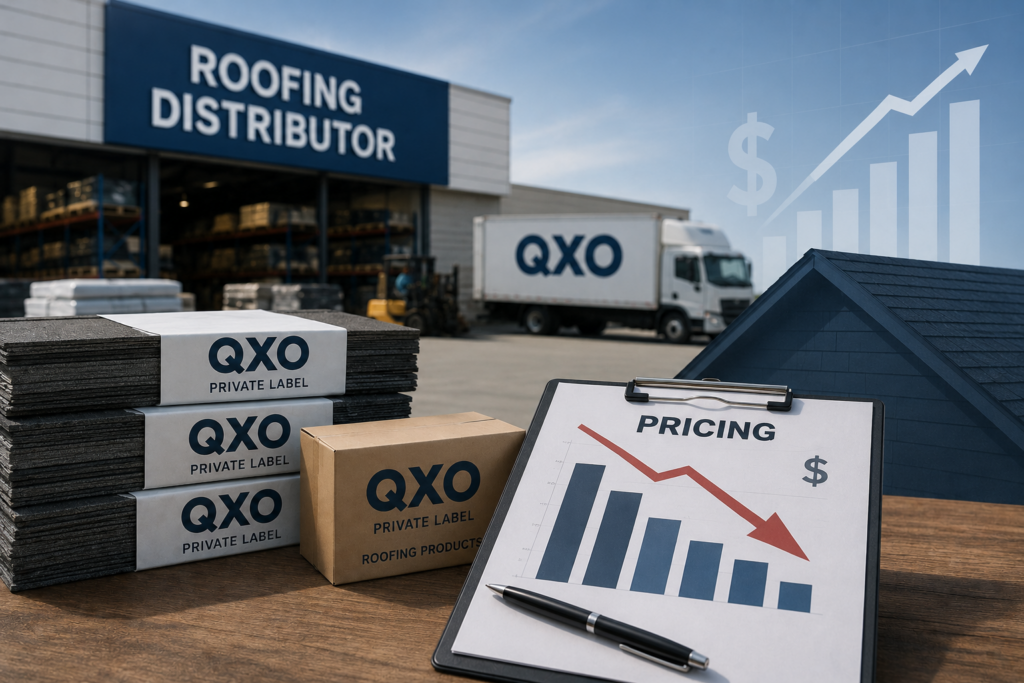
QXO has made it clear that an expanding QXO private label program will sit at the center of the company’s growth strategy, and that decision is about to ripple through every layer of the U.S. roofing distribution market.
Since closing its $11 billion acquisition of Beacon Roofing Supply in April 2025, QXO has aggressively built scale. The Brad Jacobs-led company has since added Kodiak Building Partners and announced a $17 billion acquisition of TopBuild, putting roughly $30 billion of deal activity on the table in twelve months. Together, those acquisitions give QXO around 28,000 employees and 1,150 locations across the U.S. and Canada, making it the largest publicly traded distributor of roofing, waterproofing, and complementary building products in the country.
What is less obvious from headlines is how QXO plans to convert that scale into pricing power. The answer, increasingly, is private label.
What QXO Is Doing With Private Label
QXO inherited a private label brand from Beacon called TRI-BUILT, which already sells roofing accessories, ridge caps, underlayment, and waterproofing products. Those four categories are exactly where QXO sees the largest white space for expansion.
In its latest investor Q&A, QXO told analysts that private-label products can deliver gross margins as much as 50% higher than branded alternatives. That is the math that drives the entire strategy. Every category QXO can convert from branded to private label widens the spread between what it pays manufacturers and what it charges contractors.
The QXO private label strategy is no longer just a margin tool. It is the lever the company is pulling to pressure the manufacturer side of the supply chain. QXO also said it plans to trim smaller suppliers and consolidate procurement across Beacon, Kodiak, and TopBuild operations.
How Private Label Reshapes Roofing Distributor Pricing
The biggest immediate change is on the discounting side. In September 2025, QXO publicly identified about $200 million in pricing leakage at Beacon, which Jacobs attributed to undisciplined discounting through manual pricing systems. The fix is technology, but the deeper fix is private label.
When a distributor controls the brand on a product, it controls the floor and the ceiling on price. No manufacturer is setting a list, no rebate program to navigate, and no MSRP to protect. QXO can hold gross margin where it wants it, while still selling cheaper than the branded equivalent on the shelf next to it.
QXO also described a strategy it calls “flipping the supplier relationship”. Rather than negotiating lower prices from manufacturers, QXO wants to become the customer that manufacturers prioritize, by offering broader market access, better demand visibility, and stronger digital sales channels. That is leverage. Manufacturers that lose share to TRI-BUILT will have to compete harder on price, terms, or both to stay on QXO’s shelves.
For competing distributors, this puts pressure on every line item. ABC Supply, SRS Distribution, and regional players will have to decide whether to expand their own private label programs, fight on service, or accept margin compression.
What This Means for Roofing Contractors
For roofing contractors, the practical effect of the QXO private label push will show up in three places.
Equipment costs. Private label is positioned as a lower-cost option with improved availability and faster turnaround. Contractors who are willing to spec TRI-BUILT into bids will likely see cost savings on accessories, underlayment, and waterproofing categories. On commodity components, which can move job margins by full percentage points.
Brand choice. As QXO consolidates suppliers and expands private label, branded options on the shelf will narrow. Contractors who have built their reputation around specific manufacturer brands, especially on premium roofing systems, will need to think about how to position their offering when the local distributor is steering toward its own label.
Service and digital tools. QXO has been clear that technology is the differentiator. Contractors using Beacon PRO+, the digital account platform inherited from Beacon, can expect that tool to keep getting better. Real-time inventory, order tracking, and rebate visibility are all areas QXO is investing in. That cuts admin friction and improves cash flow for contractors who use the tools fully.
The contractors who win will be the ones who treat distributor strategy as an active part of their business model, not a passive supply decision.
The Bigger QXO Picture
The QXO private label expansion fits into a bigger plan. Jacobs has said publicly that he is building QXO to reach $50 billion in annual revenue by the early 2030s, up from roughly $18 billion today. The path runs through acquisitions, integration, technology, and private label, in roughly that order.
The Beacon, Kodiak, and TopBuild deals give QXO the volume and customer base. The technology investments tighten pricing discipline and digital experience. Private label converts the resulting margin into earnings. Each piece reinforces the others.
The risk Jacobs is taking is real. Wall Street analysts have noted that the building products sector is deeply local and relationship-driven, and that scaling a tech-first model while protecting local market share will be a delicate balance. Contractors and branch managers are not always quick to embrace centralized strategies if those strategies erode service.
What Comes Next
Watch the next two quarters closely. QXO is expected to close the TopBuild acquisition by the end of Q3 2026, which will further expand its procurement scale and private label opportunity. Expect TRI-BUILT line extensions across more categories, more direct manufacturer renegotiations, and tighter pricing discipline at the branch level.
For roofing contractors, the strategic question is simple: lock in supplier relationships and pricing arrangements that protect margin if private label and procurement consolidation reduce the brand options on your local supply shelf. For more coverage of the trends shaping roofing and home services distribution, see our other industry posts.
The QXO private label push will not disrupt the roofing market overnight. But over the next three to five years, it will quietly change how roofing distributor pricing gets set, who sets it, and who keeps the margin in between.

