The biggest change is simple:
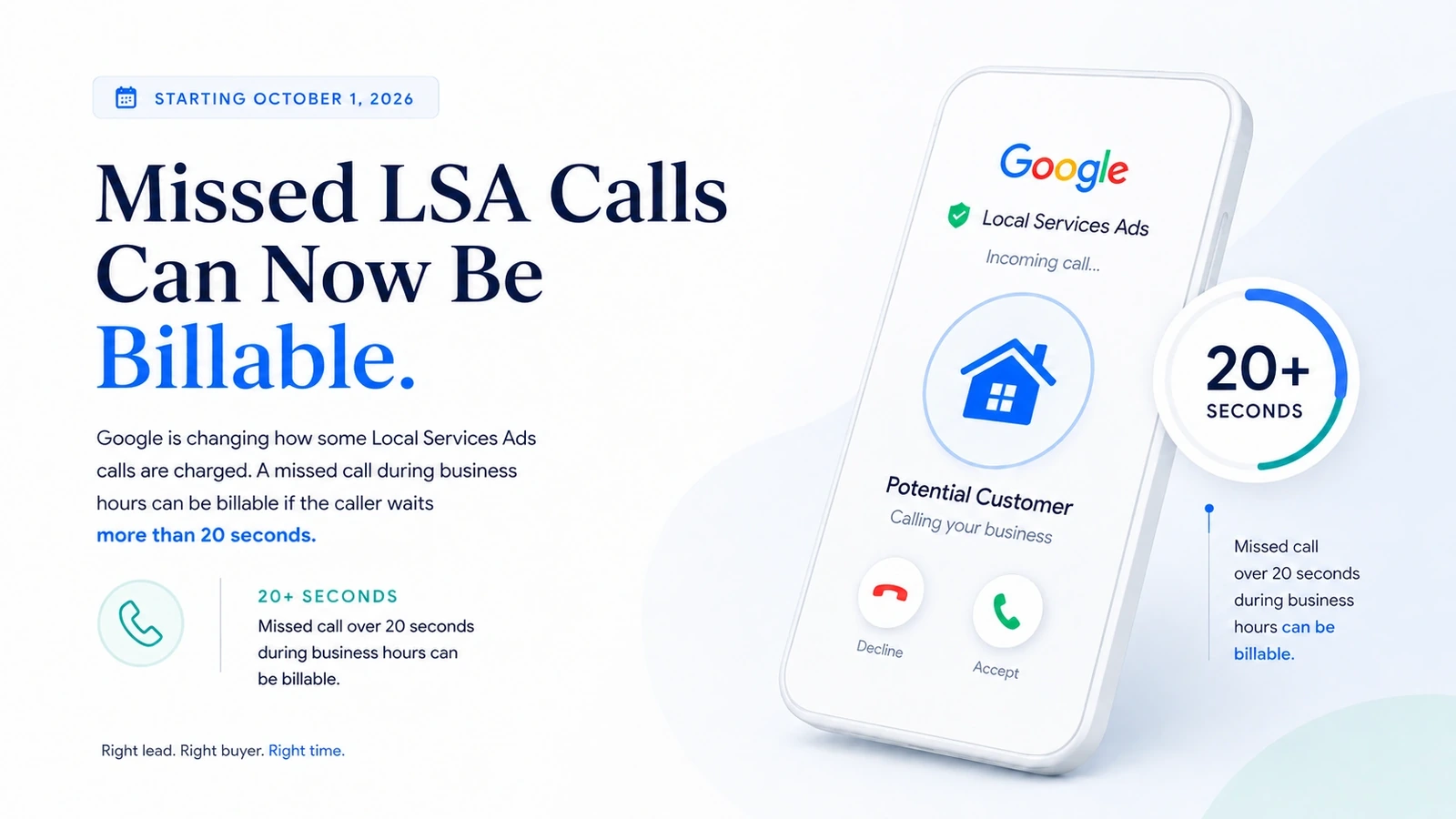
A missed Local Services Ads call during your business hours can become a billable lead if the caller stays on the line for more than 20 seconds — even if nobody at your business answers the phone.
Google is also changing how some follow-up calls are treated. If an initial call does not qualify as a charged lead, a later call between the same customer and business may become chargeable if it meets Google's valid lead criteria.
For home improvement and local service businesses, this makes call handling more than a sales issue.
It is now directly connected to lead economics.
Google LSA Missed-Call Changes at a Glance
When does the new policy begin?
October 1, 2026.
Can a missed LSA call become billable?
Yes. Certain missed Local Services Ads calls can become billable under Google's updated policy.
What is the threshold?
More than 20 seconds. If the caller remains on the line for more than 20 seconds during business hours, the missed call may qualify as a billable lead.
Does the rule apply at any time?
No. The missed-call rule applies during the business's stated business hours.
Does someone have to answer the call?
No. A missed call can potentially become billable even if nobody at the business answers.
Can a later follow-up call become billable?
Yes. If the initial call was not charged, a later qualifying interaction may become billable if it meets Google's valid lead criteria.
What happens with IVR or key-press routing?
If the caller must make a selection before being connected, the 20-second timer begins after that selection is made.
What should advertisers review before October 1?
Business hours, call routing, response times, overflow handling, missed-call processes, and overall sales-team availability.
Does Google Charge for Missed Local Services Ads Calls?
Yes. Beginning October 1, 2026, Google can charge advertisers for certain missed Local Services Ads calls.
The rule applies when a potential customer calls during the business's stated business hours and remains on the line for more than 20 seconds.
The important part is that a team member does not necessarily need to speak with the homeowner for the interaction to become chargeable.
That changes the economics of an unanswered phone.
Previously, most contractors naturally viewed missed calls as lost sales opportunities.
Now some of those calls may also become paid leads.
A roofing company, HVAC contractor, plumber or remodeling business could therefore pay Google for an opportunity that its sales team never actually spoke to.
What Is Google's New 20-Second LSA Rule?
The new policy introduces a 20-second threshold for qualifying missed calls.
If someone calls through a Local Services Ad during your business hours and stays on the line for more than 20 seconds, Google can treat the interaction as a valid chargeable lead, subject to its exceptions and lead-quality protections.
The distinction matters.
Google is not simply saying:
> Someone called you, therefore you pay.
The policy considers how the call takes place, how long the customer remains connected and whether specific exceptions apply.
But operationally, the message for advertisers is clear:
Allowing an LSA call to ring unanswered is becoming more expensive.
When Does the New Google LSA Call Policy Start?
Google's updated call lead charging policy is scheduled to take effect on October 1, 2026.
Google notified Local Services Ads advertisers of the change in August 2026.
Advertisers therefore have a short window to audit how incoming LSA calls are currently handled before the new charging rules take effect.
For businesses generating meaningful call volume through Local Services Ads, this should not be treated as a minor account update.
Call routing should be reviewed before October.
What Happens If Nobody Answers the Call?
This is the part of the change that deserves the most attention.
Imagine a homeowner searches for an HVAC company because their AC has stopped working.
They click a Local Services Ad.
They call.
The business is technically open, but the person responsible for answering is already on another call.
The phone rings.
And rings.
The homeowner stays on the line for more than 20 seconds before hanging up.
Under Google's updated policy, that missed interaction may qualify as a chargeable lead.
The HVAC company may have:
- paid for the lead,
- never spoken to the homeowner,
- never qualified the job,
- never scheduled an appointment,
- and potentially lost the homeowner to the next company that answered.
The lead did not necessarily fail because the advertising was bad.
The opportunity failed between lead generation and lead handling.
That distinction matters.
Why This Matters More for Home Service Contractors
Home-service demand is unusually time-sensitive.
Someone casually researching a new kitchen may be willing to wait.
Someone whose AC has stopped working during a heatwave probably is not.
Neither is the homeowner with:
- a leaking roof,
- a burst pipe,
- no heating,
- electrical problems,
- storm damage,
- water damage,
- or another urgent problem.
These customers often contact multiple businesses within a short period of time.
That means the commercial value of a lead can decline quickly after the initial enquiry.
A lead can be completely legitimate and still produce zero revenue because the contractor responded too slowly.
The new LSA policy makes this even more important.
Lead quality is only one part of lead value. Response infrastructure matters too.
Google Is Also Changing How Follow-Up Calls Are Charged
Missed calls are not the only change.
Google has also told advertisers that if an initial call does not qualify as a charged lead, a later interaction between the same business and customer may become chargeable if it meets Google's valid lead criteria.
For example, the first call might not meet the requirements for a charge.
But if another qualifying call occurs later, that interaction could become the chargeable lead.
Advertisers should therefore avoid evaluating Google's update as nothing more than a "20-second missed-call rule."
The broader change is that Google is expanding when a phone interaction can qualify for billing.
What If Your Phone System Asks Callers to Press a Number?
Google has included an important protection for businesses using certain automated call-routing systems.
If callers must press a key before being routed to the appropriate team or department, the 20-second timer begins after the customer makes that selection.
If the customer never makes the required selection, Google says the advertiser will not be charged on the basis of the 20-second missed-call rule.
This distinction matters for businesses using:
- IVR systems,
- departmental routing,
- location routing,
- service-type routing,
- or other automated call flows.
But adding a complicated phone tree purely to create friction would be the wrong response.
The goal should still be to connect legitimate homeowners with the right person as quickly as possible.
Does Answering LSA Calls Affect More Than Billing?
Potentially, yes.
Google's existing Local Services Ads documentation already emphasizes advertiser responsiveness.
Google states that businesses should respond to as many leads as possible and notes that regularly failing to answer calls or respond to messages may affect ad ranking.
The October billing change therefore reinforces something that was already operationally important:
Answering the phone matters.
Now the consequences can affect both opportunity conversion and lead cost.
What Contractors Should Do Before October 1, 2026
The answer is not simply "tell the receptionist to answer faster."
Contractors should look at the entire journey of an inbound lead.
1. Verify Your Published Business Hours
Start with the hours connected to your Local Services Ads setup.
If Google believes your business is open, your operation should actually be capable of handling calls during that period.
Do not advertise availability that your sales process cannot support.
If your stated hours and real call-handling hours do not match, fix the discrepancy.
2. Audit Your Call Routing
Determine exactly what happens after someone calls from an LSA.
Ask:
- Which number receives the call?
- Does it reach one person or several?
- What happens if the primary rep is busy?
- What happens during lunch?
- What happens during jobs, meetings or site visits?
- Is there an overflow destination?
- How many rings occur before voicemail?
- Does the system route based on availability?
The more dependent your system is on a single person answering every call, the more fragile it becomes.
3. Create Overflow Handling
If your primary salesperson cannot answer, the lead should have somewhere else to go.
That could mean:
- another sales representative,
- a central intake team,
- an answering service,
- intelligent call routing,
- or another properly configured backup process.
The important thing is removing unnecessary dead ends.
4. Measure Speed-to-Answer
Most companies measure how many leads were generated.
Far fewer measure what happened in the first few seconds after the phone rang.
Start monitoring:
- total LSA calls,
- answered calls,
- missed calls,
- answer rate,
- average time to answer,
- call duration,
- qualified conversations,
- booked appointments,
- and revenue generated.
You cannot improve a funnel you cannot see.
5. Review Missed Calls, Not Just Bad Leads
When lead performance drops, it is easy to blame targeting or lead quality.
But a missed call is not automatically a bad lead.
A homeowner can be:
- in the correct ZIP code,
- requesting the correct service,
- ready to buy,
- financially qualified,
- and actively looking for a contractor.
If nobody answers, the opportunity can still disappear.
That should be classified differently from genuinely poor lead quality.
6. Match Lead Volume to Actual Capacity
More leads are not always the answer.
If your team can effectively handle 30 enquiries per day and advertising generates 60, increasing spend can make the operation less efficient rather than more profitable.
Lead generation should match:
service area + project type + buyer availability + sales capacity + routing capacity.
The goal is not maximum lead volume.
The goal is maximum usable opportunity.
How the 20-Second Rule Changes LSA Economics
Historically, marketers often evaluated Local Services Ads using metrics such as:
Spend → Leads → Cost Per Lead
That view is increasingly incomplete.
A better model is:
Spend → Lead → Routed → Answered → Qualified → Appointment → Sale → Revenue
Every transition matters.
If $10,000 in advertising produces a strong lead volume but 25% of qualified callers are never reached, the problem may not be acquisition.
It may be the infrastructure immediately after acquisition.
This is especially important for businesses buying leads across several territories, service categories or sales teams.
A lead-generation system is only as useful as the business's ability to act on the opportunities it creates.
Lead Quality and Lead Handling Are Not the Same Thing
This distinction is worth making clearly.
A bad lead might be someone who:
- wants a service you do not provide,
- lives outside your service area,
- entered incorrect information,
- cannot be contacted,
- or has no legitimate intent.
A badly handled lead can be completely different.
It may be a legitimate homeowner with a real project who simply reached the business at the wrong moment.
Those two situations should not be grouped together.
If they are, marketing teams end up optimizing campaigns using incomplete feedback.
Acquisition gets blamed for problems that actually occurred downstream.
The Bigger Lesson for Contractors
Google's new policy highlights a broader change happening across performance marketing.
Generating the enquiry is no longer enough.
Businesses need control over what happens after it arrives.
For home improvement companies, that means knowing:
- where a lead should go,
- who is available,
- whether the project fits,
- whether the ZIP code is serviceable,
- whether sales capacity exists,
- how quickly someone responds,
- and what ultimately happens to the opportunity.
At IntelHouse, we think about lead generation through that full path.
Right lead. Right buyer. Right time.
Because an exclusive lead that reaches the wrong person at the wrong moment can still be wasted.
Frequently Asked Questions
Does Google charge for unanswered Local Services Ads calls?
Beginning October 1, 2026, certain unanswered Local Services Ads calls can become chargeable. A missed call during business hours can qualify as a valid lead when the caller stays on the line for more than 20 seconds, subject to Google's exceptions and protections.
What is the Google LSA 20-second rule?
The 20-second rule refers to Google's updated policy for certain missed Local Services Ads calls. If a user calls during the advertiser's business hours and stays on the line for more than 20 seconds, the missed call may become a chargeable lead.
When does Google start charging for missed LSA calls?
The updated policy is scheduled to begin on October 1, 2026.
Does somebody need to answer the call for Google to charge for the lead?
Not necessarily. Under the updated policy, some calls that remain unanswered can still qualify as chargeable leads when the relevant criteria are met.
Can Google charge for a follow-up call?
Yes. Google says that when an initial call does not qualify as a charged lead, a subsequent call between the business and the customer may be charged if it meets valid lead criteria.
Does the 20-second timer apply to IVR systems?
When a phone system requires a customer to press a key to be routed, Google says the 20-second timer begins after the customer makes the selection. If the customer does not make the required selection, the missed-call rule does not apply in the same way.
Should contractors shorten their business hours because of the change?
Not automatically. Business hours should accurately represent when the company is available to serve customers. The better response is to make sure call-handling capacity matches the hours being advertised.
How can contractors reduce missed LSA opportunities?
Businesses should review their business hours, call routing, overflow handling, speed-to-answer, sales capacity and missed-call reporting. The goal is to make sure legitimate enquiries reach an available person quickly.
Final Takeaway
From October 1, 2026, a ringing phone from Google Local Services Ads is no longer something advertisers can afford to view as simply "a call we missed."
If that caller remains connected for more than 20 seconds during business hours, the interaction may become a billable lead.
That puts a much brighter spotlight on the part of the funnel many businesses overlook:
what happens after the lead is generated.
The companies that adapt will not necessarily be the ones generating the most enquiries.
They will be the ones that route the right opportunities to the right people quickly enough to turn those enquiries into conversations, appointments and revenue.
About IntelHouse
IntelHouse helps home improvement businesses generate exclusive, real-time customer opportunities and route them based on the criteria that actually determine whether a lead can be worked — including service category, geography, buyer availability, project type and delivery requirements.
Our focus is not simply generating more leads.
It is helping the right opportunity reach the right buyer at the right time.
Want to improve how your home improvement lead flow is generated and delivered? Talk to IntelHouse.
Editorial Sources
This article is based on Google's August 2026 Local Services Ads advertiser communication regarding upcoming call-lead charging changes, together with Google's current Local Services Ads documentation covering lead handling, phone calls and advertiser responsiveness.
Primary reference: Google Local Services Ads / Local Services Help Policy update reporting: Search Engine Land, August 25, 2026 Policy effective date: October 1, 2026